There are two important factors to consider in understanding what it meant to be a ‘Goan in Karachi’ “ that fine line of disparity that separated two pedigrees. The original settlers who came here in 1840-1850 spoke in Konkani only, with a dabble of Portuguese and English. Being in Karachi then, with the British calling the shots, Goans chose English as their ‘lingua franca’ to be their ‘mother tongue’ so it could open doors of opportunities.
As prospering Goans made their way up the ladder, they left Konkani behind to be spoken by their parents and caretakers, relegating the language to the ‘kuzna’an’ (kitchens). This trend continued well into the 20th century and at the time of independence, Konkani was not so popular among a section of Goans. But by then, the language flourished and was spoken by a larger segment of the community with ‘Little Goa’ (the neighbourhood of Saddar) making an indelible impact on all that was ‘Goan’ in Karachi. In the years to follow, many were to regret they did not speak in Konkani and therefore, were poorer not knowing ‘amchi bhas’ “ their real mother tongue.
Kudds opened in the early 1900s when several bachelor-Goans started arriving in Karachi. Better known as ‘Tarvottis’ their lives were a true story of ‘unity and brotherhood’ when they rented rooms to live together. From the 1930s to 1960s about 20 Kudds functioned, each one accommodating up to 15 individuals, and each club having an extended membership of no less than 50 persons (all belonging to the same village). The Kudds were managed meticulously by a committee.
Every Kudd in Karachi was typical in its get-up, a magnificent teakwood-crafted altar, handmade by the highly skilled Goan carpenters who had arrived in the city. A typical day in the Kudd included the daily ‘Rosary’ at Angelus time, Konkani hymns (harmony et’al) and the ‘Litany’ (Laudain) with music by skilled violinists; and later after the services, singing, socialising and arguments “ all in Konkani! The Feast of St Francis Xavier was an annual affair at all the clubs in the city, preceded by a special Mass in the Cathedral.
Norbert de Souza, a Goan from Karachi in Toronto, recalls life in Kudds in my book, Footprints on the Sands of Time, “…my dad, like others worked with the British army in the 1920s, the clubs were the happiest places to spend their weekly off days; those early years were the loneliest periods in their lives. These humble clubs were the first abode of our forefathers when they landed as bachelors from all over India.”
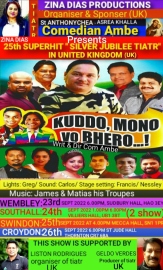
Tiatrs in Karachi were a “sold-out” fad from the 1920s through the 1960s. Goan ‘tiatrists’ were a breed apart, their colourful dispositions and presentations at the famed ‘Katrak Hall’ and the Goan Association halls, were hilarious. “Some soloists got encores and others pelted with eggs and tomatoes; at intervals there were skirmishes among rival groups but all in good spirits (real spirits!) and the show carried on,” a memory recalled.
Goa’s famous tiatrist son, Alfred Rose’s father Ambrose Fernandes, a celebrated tiatrist of his time, was among the first in Karachi in the 1920s to write and stage tiatrs here. Popularly known as AMB Rose, he received his early musical education from the maestros of Karachi. Upon returning to Goa, he passed on his talent to his legendary son.
From the 1970s-1990s, a small group of Konkani speaking enthusiasts staged some wonderful tiatrs namely, ‘Afrikacho Nauro’ (1975, produced and directed by Gregory Coutinho), and ‘Bebdo Gorkar’ (1990), ‘Goencho Badkar’ (1992) and ‘Miracle of St Anthony’ (1994) “ all produced and directed by Bernard D’Souza. These activities gave birth to the formation of ‘Goenkars’ Own Academy’ in 1992, an offshoot of the KGA, founded by Norbert Coutinho (a former president); carried on by Deborah Fernandes/Santamaria until 2016, and now regrouped in 2020 to be led by Peter Mendes.
Next: Musicals and Church Choirs