


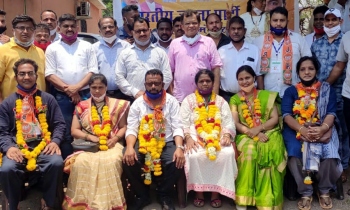
 The winning candidates from the BJP panel with former MP Narendra Sawaikar and ex-MLA Subhash Phaldessai.
SANGUEM
The BJP had to bank on the support of an independent candidate to take control of the Sanguem Municipal Council (SMC), after its panel won in five of the 10 wards in the municipality.
The SMC will see as many as seven new faces in the 10-member council, after three sitting councillor were defeated in the polls.
The BJP panel had fielded candidates in all 10 wards, but only five of its candidates, Santiksha Gadekar (Ward 3), Sayyed Ikbal (Ward 4), Pritee Naik (Ward 5), Queiroz Cruz (Ward 7) and Sweta Naik Tari (Ward 9) won their elections.
The BJP panel then had to seek the support of independent candidate Archana Gaokar (Ward 10) to claim majority in the 10-member council.
The four other winning candidates were Romualdo Judas Agnelo Fernandes (Ward 1), Messiah Da Costa (Ward 2), Fouziya Shaikh (Ward 6) and Sangameshwar Naik (Ward 8).
The BJP suffered a severe setback in Ward 2 as efforts by top BJP leaders in Sanguem failed to ensure the defeat the young and upcoming leader from Sanguem, Messiah Saude Da Costa, a close aide of Savitri Kavlekar.
Messiah polled the maximum votes (270) in the 10-member council, while his nearest rival and ex-councillor Sandesh Narayan Kossambe secured only 54 votes.
Incidentally, both candidates, Fouziya Shaikh and Romualdo Fernandes, who had led the legal fight against the ward reservation policy by the DMA, which went right up to the Supreme Court, won elections from their respective wards.
7-TERM COUNCILLOR OUSTED
SANGUEM: After having represented the Sanguem Municipal Council (SMC) since the last 35 years, outgoing chairperson and seven-term councillor Sanjay Raikar’s unbroken stint in the council finally came to an end by a close margin of 18 votes.
The fight for Ward 6 was the closest in the SMC elections, as sitting councillor Fouziya Shaikh (212 votes) defeated Raikar (194 votes) by a mere 18 votes.
Incidentally, Raikar had to contest from the neighbouring ward after his ward had been reserved for an OBC candidate, when the Supreme Court upheld the order of the high court in the ward reservations.


