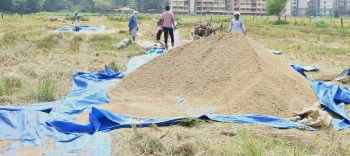
 Bumper paddy yield reported by the farmers on the government acquired fields opposite the Margao railway station. Captured by : Santosh Mirajkar
MARGAO
A bumper paddy harvest has once again brought smiles to the beleaguered farmers of Aquem and Rawanfond ” but it has also reignited a critical debate: should this land continue to serve agricultural purposes as the “lungs” of the city, or be converted into a commercial hub with retail spaces, innovation labs, and hospitality facilities?
The land in question, measuring around 28,000 square metres, was acquired by the Goa State Urban Development Agency (GSUDA) in 2003 for the proposed construction of a transportation centre. However, more than two decades later, the displaced farmers continue to cultivate paddy there ” and some have even begun growing a second crop with the help of irrigation facilities.
With the paddy yield improving every year, farmers are renewing their plea for the government to return the land for exclusive agricultural use.
Despite these appeals, the government seems intent on pursuing different plans. The property, fenced off with barbed wire a few years ago, remains under GSUDA’s watchful eye. This became evident when GSUDA appointed Mumbai-based consultant Studio Pod to prepare a proposal outlining various commercial activities for the land located opposite the Margao railway station.
Falling within Zone Three (South Margao), the area is identified in the Master Plan as a new economic node connected to the city through a proposed transit loop. While the plan does not explicitly earmark the GSUDA-acquired land for development, it envisions an innovation hub in the vicinity, incorporating retail, art and culture spaces, entertainment zones, incubation and innovation labs, hospitality units, and multipurpose facilities.
On Wednesday, progressive farmer Claudius Dias expressed joy as he and others reaped a bumper harvest from the ancestral fields. “The government acquired our fields in 2003 for a transportation centre. Later, it even tried to allot part of the land for rehabilitating displaced hawkers from the Rawanfond junction. But since then, we farmers have continued cultivating these fields without fail,” he said.
He added: “These paddy fields act as the city’s lungs. The government should scrap any plans for commercial exploitation and return the land solely for agriculture.”
Dias further argued that since the land has remained unused for its intended purpose, it should be restored to the farmers. Detailing the harvest, he said the 28,000-square-meter area yielded 12“15 tons of paddy this year ” enough to sustain their livelihoods, with surplus rice sold in the market to offset cultivation costs.
Service provider Moreno Rebello, who supplied the mechanical harvester for the harvest, echoed the farmers’ sentiment. “The government must listen to the farmers and restore their fields,” he urged. “These are golden fields that were forcibly acquired. Instead of creating hardship for farmers, the government should support them and return the land. Subsidies for service providers should also be credited promptly to help us serve the farming community better.”
For now, the farmers’ success in registering yet another rich yield from the fertile soil stands as a reminder that this land continues to thrive as an agricultural heart ” even as its future hangs in the balance between development and preservation.