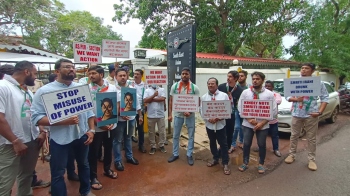
With the shrinkage of cultural values and moral norms within society, a Bill which seeks to preserve the identity of a historically predefined set of people from being diluted against the backdrop of heightened political inclusivity, the authoritarian culture of the incumbents needs to be evaluated in light of the moral policing efforts which seems excessively inclined towards a faction of the ruling class.
A healthy debate on the facets that define Goan culture and the traditional norms of inclusivity into the community needs to be welcomed in order to truly allay the apprehensions of the minorities and the disadvantaged class of Goans who see change as a paradigm for the promotion of selfishness.
With the POGO (Persons of Goan Origin) Bill declined from being tabled in the assembly due to the ruling government deeming it unconstitutional, certain procedures would demand their mandatory compliance according to “The Rules of Procedure and Conduct of Business of the Goa Legislative Assembly, 1992”.
From a parliamentary historical perspective, the last time that a Bill was negatived in the lower house of the Union Parliament was in the year 2011 when “The Constitution (One Hundred and Sixteenth Amendment) Bill, 2011” was sought to be introduced.
In the present scenario wherein the honourable CM chose not to table the POGO Bill for want of constitutionality, the procedural safeguards generally prescribed needed to be followed with the utmost transparency and objectivity.
The prerogative whereby a bill can or cannot be introduced in the assembly lies exclusively with the Speaker.
Rule 2 specifies that “Speaker” means the person holding the office of the Speaker under Article-178 of the Constitution of India. Incidentally, this is a constitutional designation distinct from that of the Chief Minister.
Rule 130 specifies that if notice is given of a motion to introduce a Bill which in the opinion of the Speaker, cannot be introduced, save with the previous sanction or recommendation of the Governor, the Speaker shall, as soon as may be after the receipt of the notice, refer the Bill to the Governor.
It would be procedurally justified for MLA Viresh Borkar in the capacity of a private member of the legislative assembly who desires to move for leave to introduce a Bill to give notice of his intention and together with the notice submit a copy of the Bill and a Statement of Objects and Reasons before the House.
While the Constitutionality of the POGO Bill has come under scrutiny, it needs to be clarified that Article 14 of the Constitution of India does not treat unequals equally.
While equality before the law is a fundamental right enshrined in Article 14 of the Constitution, reasonable classification is still permissible based on intelligible differentia.
A reasonable classification must be based on smart differences. This means that collectively grouped persons or things make a properly defined, distinct class and may be exceptional from those left out of the group.
What the above statement implies is that unlike objects shall not be treated similarly.
The expression “intelligible differentia” means difference capable of being understood. A factor that distinguishes or in different state or class from another which is capable of being understood.
Going through the proposed POGO Bill, it becomes evidently clear that the bill seeks to elucidate a threshold whereby certain persons conforming to certain criteria can be ascribed as being persons of Goan origin.
There exists nothing unconstitutional in defining the limits of reasonable classification based on intelligible differentia whereby a certain vulnerable region can seek to protect the identity and defining characteristics of its dwindling citizens.
The issue arises around the thresholds of inclusion and exclusion which can easily be debated in the house after inviting the report of the select committee.
Moreover, the ultimate test for passing any bill still remains dependent on the constitutional safeguards in being able to secure the assent of the Members of the House according to the requisite quorum.
The incumbent government refusing outright to table the POGO Bill without following procedural safeguards may be damaging to the fundamental right of free speech and expression guaranteed under Article 19 (1) (a) of the Constitution.
Moreover, in the rare instance that a Bill tabled by a private member outside the ruling government is voted into law, even then Article 13 provides for Judicial Review whereby the Constitutionality of any legislation passed by the House may be reviewed by the Courts of Law under their original jurisdiction.
At the very least, the Speaker could consider referring the bill to the “Select Committee” which means a Committee of Members to which a Bill is referred by the Assembly for consideration and report.
Even though the Bill may have been legally vetted by the law department, it still remains unclear as to whether the reasons provided by the Law Department pertaining to the unconstitutionality of the POGO Bill find similarity in opinion to the speaker of the House who ultimately has to decide upon the introduction of the Bill in the capacity of a Constitutional Functionary.
While the place of the Judiciary may be carved into a niche by the Chapters in the Constitution, a persuasive power still emanates from even the slightest obiter dicta that a Justice from the Highest Court in the State can observe and perhaps it would be in the interest of judicial activism for the Court to step in Suo Motu and ascertain the Constitutionality of the POGO Bill.