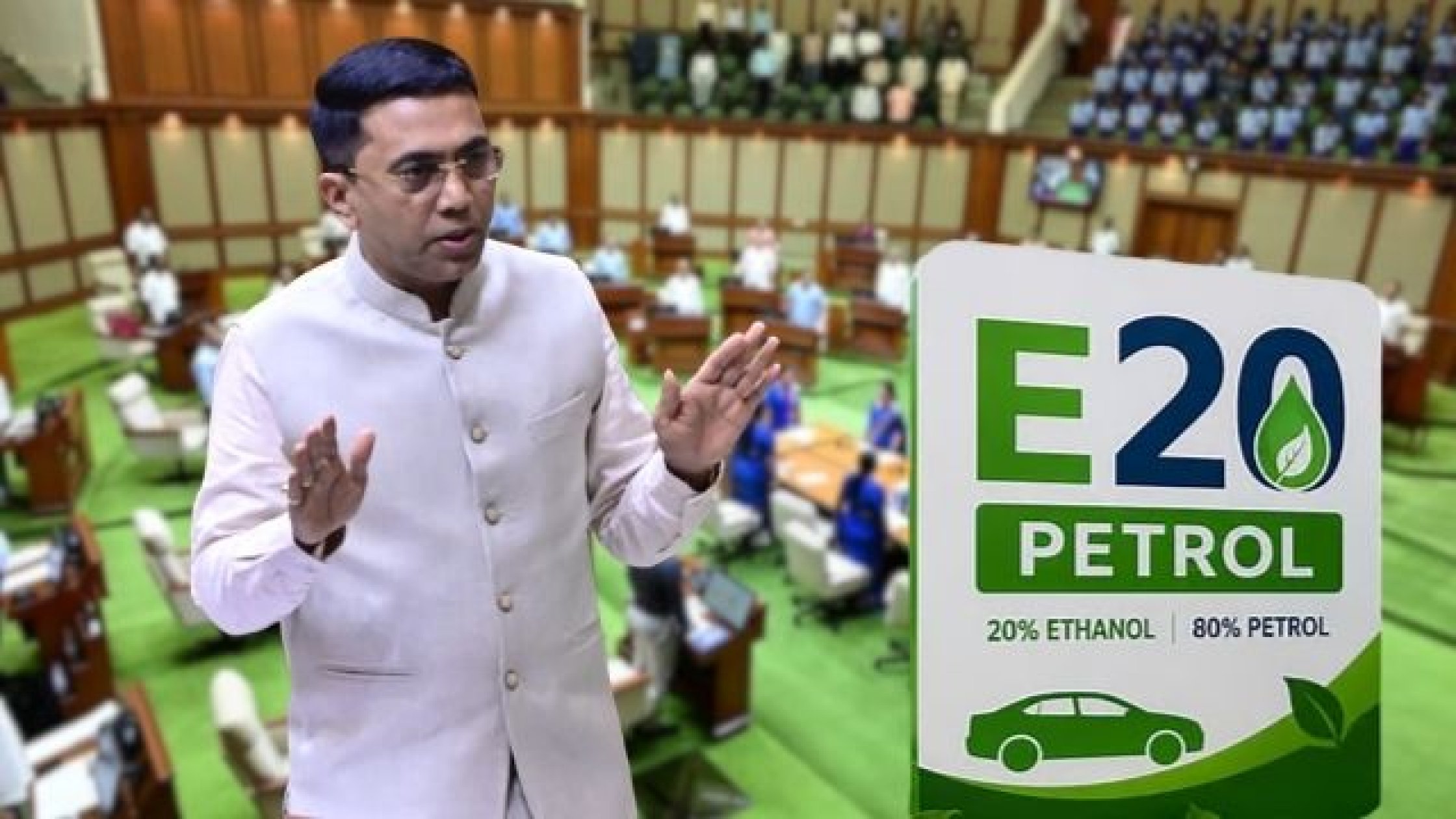
PANAJI: Chief Minister Pramod Sawant has stated that the Goa government has not received any complaints from consumers, vehicle owners, automobile associations, transport operators or garages regarding E20 petrol.
Sawant was replying to a Calling Attention Notice raised by MLAs Venzy Viegas, Vijai Sardesai and Cruz Silva in the House today over concerns about E20 petrol, particularly its impact on older vehicles, taxi operators and two-wheeler riders. The MLAs had sought government intervention with the Centre to ensure consumers have the option of purchasing unblended petrol, especially for older vehicles.
Sawant said E20 petrol was introduced in Goa in 2025 and is currently supplied through 157 retail outlets operated by Indian Oil Corporation Limited, Bharat Petroleum Corporation Limited and Hindustan Petroleum Corporation Limited.
“The Department of Civil Supplies and Consumer Affairs has not received any complaints or representation from consumers, vehicle owners, automobile associations, transport operators or garages regarding E20 petrol,” Sawant said.
He said the Centre has also reported no widespread or substantiated complaints regarding fuel efficiency, engine performance, maintenance costs or vehicle reliability due to E20.
According to Sawant, studies conducted by the Automotive Research Association of India (ARAI), Society of Indian Automobile Manufacturers (SIAM), Indian Oil Corporation Limited, Indian Institute of Petroleum and automobile manufacturers have examined engine durability, drivability, corrosion, material compatibility, emissions and fuel efficiency.
“These studies have confirmed that E20 is safe for use under prescribed standards,” he said, adding that legacy vehicles had not shown significant performance changes or abnormal wear and tear attributable to E20.
On mileage concerns, Sawant said fuel efficiency depends on driving conditions, driving habits and vehicle maintenance. Any reduction in fuel economy in certain E10-designed vehicles is generally around 3-5%, he said.
Citing Central Government data, Sawant said more than 20 crore two-wheelers and over 3 crore petrol cars were operating on ethanol blends as of July 2026, without verified evidence of widespread engine failures or breakdowns attributable to ethanol blending.
He also said the ethanol blending programme has resulted in more than Rs 1.97 lakh crore in foreign exchange savings, substitution of nearly 316 lakh metric tonnes of crude oil, reduction of around 952 lakh metric tonnes of CO₂ emissions, and transfer of over Rs 1.66 lakh crore to farmers, according to the Centre.
Sawant said oil marketing companies conduct fuel quality checks at distilleries, depots and retail outlets. Following complaints, more than 30,000 quality checks were conducted at retail outlets in the last 10-20 days to detect adulteration and ensure compliance with fuel standards.
He also pointed out that India’s ethanol blending programme predates the present government, with a pilot launched in 2001, formally announced in 2004 and E5 petrol rolled out across several States by 2006.