


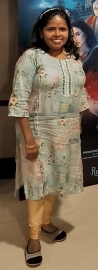
 Vailankani Mearl Camilo
Vailankani Mearl Camilo’s story speaks of grit and commitment, dedication and a die-hard-spirit. With a unique disability called ‘dwarfism’ Mearl (as she is known) finds herself as a joyful and blessed soul amongst loving family members including her mother, four brothers, a caring husband and other relatives.
Mearl completed SSC from St Joseph High School at Aquem in 1999 and HSSC from Higher Secondary School at Nuvem in Arts in 2001. She learnt candle making during holidays. She also completed a computer course through NIIT in 2000 and graduated in Economics from Carmel College of Arts and Science at Nuvem in 2004.
Her journey as a working woman began at Goa Shipyard Limited, Vasco as an apprentice in 2004. “I approached the concerned authority and asked to give me opportunity and assign tasks, and when they did so, there was no looking back. I gained appreciation from my superiors. I learnt typing and completed diploma in Secretarial Skills through STENODAC in 2006. Then I joined Goa College of Engineering as junior stenographer in 2007. My hobbies led me to join courses like flower making, ribbon embroidery, beadwork and music. Continuing my studies, this year (2024), I did my Masters in Public Administration through IGNOU.”
As a 26-day-old newborn she hung between life and death due to some complications. Little Mearl survived that blow. However, her mother noticed when Mearl was five that her growth seemed to be retarded. Mearl faced a lot of eve-teasing and detested the idea of going to school.
She shares, “Every single day I would return home crying but my mother showed lot of patience. She picked and dropped me to school throughout my school and college life. Then words from a stranger came as a balm. The stranger told me, “Don’t feel bad when people look or tease you. If children tease you they do so as they are innocent. If adults tease you they do so as they are foolish and have not encountered you. If they know you well they will never tease you. These words changed the way I perceived people.”
Performing in a musical opera ‘Pormollit Sallok’ organised by the Carmelite Monastery Margao where Mearl played the role of little Theresa, was a lovely experience which gave her the needed impetus to open up. “The world is beautiful and every day is a gift of God so one must live well and also make it beautiful for others. God has always sent me angels in the form of persons who helped me through my life. I meet the right people at the right time,” she said. She is thankful to her instructor Shweta Cardozo from Stenodac who guided her to type without looking at the text with great speed.
Having lost her father when she was a kid, her mother worked hard to bring her five children up “ Mervin, Milburn Harold, Melroy, Marc and Mearl. It was because of her brother Milburn that she learnt to drive a four-wheeler in 2010. “I struggled to get a vehicle modified as per my requirements. It was Ferdinand Rodricks, proprietor of Ferro Equip, in Mumbai (www.mobilityenhanced.com) who modified my vehicle. He gave me wings to fly and eased my life to a great extent. I had to learn the car on my own with the motivation from my brother Milburn,” says Mearl who got married in 2023.
“My husband is blessing in my life who not only accepted me but with his help and support I was able to attempt Masters and successfully completed it with flying colours. He is very calm which was much needed in my life,” says Mearl who is also thankful to the director of Technical Education Dr Vivek Kamat for his encouragement. “I owe my drafting skills to him. I also thank the present Principal of Goa College of Engineering, Dr Krupashankara M S, where I am presently posted for his guidance, help and understanding,” says a humble Mearl who also aspires to be a junior scale officer in Goa government and maybe an IAS someday.
Mearl feels that a grassroot survey to collect the data of PwDs in each ward is a must to devise a strategy by the government to help them. The block development officers can identify the PwDs and the Swampurna Mitras can visit them to resolve issues. NGOs can also be roped in. Secondly, buildings and public transport must be barrier-free.
Technology can help PwDs to learn new things within the comfort of their homes, to be self-employed and government must envisage a laptop scheme for the PwDs, she suggests and appeals to youth not to waste time, to respect their parents and look after them in their old age.


