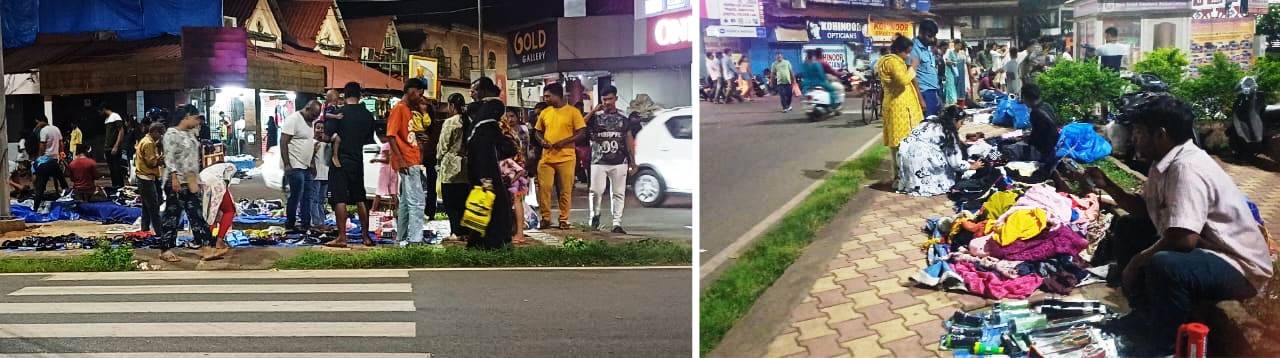
 Encroachments reigned supreme on Margao’s footpaths on Sunday despite a recent Supreme Court judgement upholding citizens’ right to walk freely on footpaths as a fundamental right. Captured by : Santosh Mirajkar
MARGAO
Has street vending on public footpaths come to an end following the Supreme Court’s recent judgement upholding pedestrians’ fundamental right to walk freely on footpaths?
A visit to Margao on Sunday appeared to suggest otherwise. The footpaths in front of the Margao Comunidade Square, located adjacent to the Margao Municipal Council (MMC) building, were bustling with street vendors conducting business as usual. Vendors occupied large stretches of the pedestrian pathways, forcing walkers to navigate around them or step onto the road.
What was equally striking was the absence of any enforcement personnel. Neither MMC officials nor municipal workers were seen at the site, while police personnel were also conspicuous by their absence. No effort appeared to have been made to prevent or regulate the occupation of the footpaths despite the Supreme Court’s recent ruling emphasising the rights of pedestrians and the need to keep public pathways free from obstruction.
It remains unclear whether Margao Municipal Chief Officer Madhu Narvekar has taken cognisance of the apex court’s observations and directives. Questions are now being raised over whether the civic administration has initiated any measures to ensure compliance with the judgement, including deploying municipal staff or coordinating with the police to prevent illegal vending on footpaths.
Observers pointed out that Sunday being a holiday cannot be used as an excuse for the lack of enforcement. In fact, the issue assumes greater significance on weekends when commercial activity is high and pedestrian movement increases in the town centre.
Sources in the know maintained that the Margao Municipal Council need not wait for fresh instructions or a circular from the Directorate of Urban Development to act. They pointed out that the civic body is already bound by judicial directives issued by the High Court in 1997.
Directing civic authorities to keep footpaths free from encroachments and ensure unobstructed access for pedestrians.
For years, successive city fathers and municipal officials have defended their inability to tackle encroachments by claiming that vendors typically occupy footpaths after municipal offices close for the day at around 5.45 pm, making enforcement difficult. However, Sunday’s scene has reignited the debate over whether such explanations can still hold ground.
Civic activists argue that if encroachments continue beyond office hours, it is incumbent upon the municipal administration to evolve an effective enforcement mechanism. They contend that the MMC should consider establishing a dedicated anti-encroachment squad or introducing a shift-based monitoring system to ensure compliance with court directives round the clock.
The continued occupation of footpaths has also raised concerns about pedestrian safety, accessibility for senior citizens and persons with disabilities, and the overall credibility of civic enforcement.
With the Supreme Court having once again underscored the primacy of pedestrians’ rights over public pathways, citizens are now waiting to see whether the Margao Municipal Council and law enforcement agencies will translate the court’s observations into action on the ground.