


PANAJI
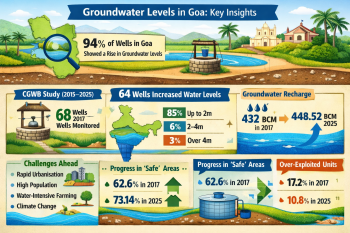
More than 94 per cent of monitored wells in Goa have shown a rise in groundwater levels, pointing to an overall improvement in the State’s water table, according to data released by the Central Ground Water Board (CGWB).
Information shared by the Union Ministry of Jal Shakti in the Rajya Sabha shows that the CGWB studied 68 wells across Goa between 2015 and 2024, and reassessed them after the monsoon in 2025. The 2025 post-monsoon data was compared with the average levels from the previous decade to understand long-term trends.
The results show that 64 of the 68 wells recorded an increase in water levels, while only four saw a decline. Importantly, none of the wells showed a drop of more than four metres.
Most wells ” 58, or nearly 85 per cent ” recorded a rise of up to two metres. Four wells saw an increase of between two and four metres, while two wells recorded a rise of more than
four metres.
At the national level, groundwater conditions have also improved. CGWB data shows that about 73.25 per cent of wells across India recorded higher groundwater levels in the 2025 post-monsoon period compared to the 2015“2024 average.
The Ministry said total annual groundwater recharge in India has increased from 432 billion cubic metres (BCM) in 2017 to 448.52 BCM in 2025. The share of ‘safe’ assessment units has gone up from 62.6 per cent to 73.14 per cent, while over-exploited units have fallen from 17.2 per cent to 10.8 per cent, indicating an overall improvement.
However, the Ministry cautioned that some regions may still face seasonal groundwater stress due to rapid urbanisation, high population density, water-intensive farming, inefficient irrigation, and climate change.
It also stressed that water is a State subject, and the main responsibility for groundwater management rests with State governments.
The Centre continues to support states with technical and financial assistance under various schemes.
The Ministry added that the CGWB has prepared the “Master Plan for Artificial Recharge to Groundwater“2020” for the entire country, including Goa.
The plan serves as a guide for rainwater harvesting and building recharge structures to support sustainable groundwater management.


