


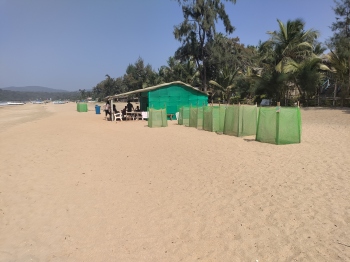
 Nine Olive Ridley pits protected at Agonda Turtle Rehabilitation Centre and two at Galgibaga turtle reserved beach. Captured by : Kathy Fernandes
CANACONA
Nine hundred and sixty-nine Olive Ridley eggs are protected at the two Turtle Rehabilitation Centres at Agonda and Galgibaga turtle reserved beaches with as many as 9 female turtles visiting Agonda beachcoast alone.
On Thursday night, one flipper came, laid 77 eggs and returned to the sea, while soon after the Forest Department engaged personnel to shift the eggs into a pit excavated by them at the nursery near the rehabilitation centre.
With the arrival of the 9th female turtle at the otherwise busy shore, Agonda Beach alone protects 803 Olive Ridley eggs, while the other turtle reserved beach at Galgibaga hosts two turtle pits together carrying 172 eggs.
The Forest Department is virtually on Cloud Nine for having received 9 female turtles on Agonda beach within a short period of time since the first nursery is protected, which otherwise is often busy due to tourism activities taking place on the entire 2.9 km beach stretch.
"The flippers seems to be more interested to come in Agonda shore than on any another shore notwithstanding some or other disturbances, and we expect more turtles to come and lay eggs in the next few months. It's a good sign the female Olive Ridleys feel safe to lay eggs at Agonda than on any other beach coasts," informed a forest department source.
The other turtle reserved beach at Galgibaga where forest department has acquired land for turtle conservation project has so far received only two female turtles, and the pits are protected in two seperate enclosures at the Turtle Rehabilitation Centre.
However, more turtles are expected to visit Galgibaga beach too as earlier too female turtles lay their eggs even past April month. With the period of procreation somewhere between 55-58 days, Olive Ridley hatchlings come out even during rainy season.


