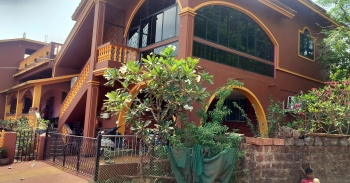
 POWER AND PELF: Lala’s elegant bungalow an enduring symbol of privilege and political influence in Tivim. Captured by : Agnelo Pereira
MAPUSA
As the relentless roar of bulldozers echoed through the narrow lanes of Auchit-Vaddo, Tivim, levelling 23 homes labelled illegal by the High Court, one man sat unaffected in his spacious balcony watching the chaos unfold just behind his palatial bungalow.
That man was Lala Ismail Bepari “ the namesake of “Lala ki Basti,” a settlement of migrant families that once stood on Comunidade land in survey no. 343.
As walls crumbled and tiled roofs fell, Lala appeared composed, almost detached, from the very storm his name had come to symbolise.
A name that became a local landmark
“Lala ki Basti” didn’t just emerge overnight. The settlement earned its colloquial name from Lala Ismail Bepari, whose family has been tenants on this Comunidade land since Portuguese times, according to land records Form I and XIV.
“The property belongs to the Comunidade. My father was a tenant long before liberation,” Lala reminisced during a candid conversation with this journalist.
But over the years, the land around him transformed.
Illegal homes cropped up. Families settled. Power lines and water taps were connected. And through it all, Lala’s influence loomed large.
Power, politics and patronage
Lala is no ordinary man in Tivim. A former panchayat member for three terms and sarpanch in 1985, he has wielded influence over local politics and development for decades.
“We helped Sadanand Tanavde win his first election in Tivim. I also supported Nilkant Halarnkar when he was just starting out in politics. Even Narvekar had a good relationship with me,” he said, smiling.
His wide network, Lala claims, extended to both the Comunidade and the local panchayat, which, according to him, were always “good” to him.
Despite his political clout, Lala never won an assembly seat himself “ though he contested a few times.
More often, he played kingmaker, shifting loyalties between political parties during election seasons.
A role in the rise and fall of the basti?
Lala has long been accused of enabling the illegal settlement to flourish. Residents and activists claim he helped facilitate the growth of the basti by aiding migrants with access to basic infrastructure “ most critically, water and electricity.
Lala doesn't deny this. But he draws a line.
“We didn’t sell land or divide it into plots. We didn’t bring people here. They built houses on their own,” he insisted.
“In some cases, the Comunidade gave them an NOC. We just helped with connections for survival,” he added.
Most residents, he said, are from Karnataka, but there are also Goans among them.
“These are poor people. Daily wage workers. Many of them live hand to mouth,” he added, acknowledging the stark reality of those who lost their homes.
From Auchit-Vaddo to ‘Lala ki Basti’
Interestingly, Lala challenges the very name of the locality.
“This area is called Auchit-Vaddo,” he clarified. “It was RGP leader Manoj Parab who popularised the name ‘Lala ki Basti’ for political mileage. He comes here, takes photos, records videos and then talks big. He plays caste politics and tries to scare the people,” he added.
Lala also hinted that more demolitions are likely, as the legal scrutiny over illegal structures continues.
But instead of watching the basti vanish piece by piece, he said he wants to help legalise what remains.
“I will ask them to legalise these houses. I already requested the Comunidade to regularise them if the residents are willing to pay the required fees,” he said.
Two worlds, one village
As the dust settled on the demolished homes, a stark image emerged: the shattered remains of tin roofs and broken dreams on one side, and on the other, Lala’s elegant bungalow “ unscathed and untouched, a symbol of privilege and power.
The contrast couldn't be more jarring. In the same neighbourhood, some live by the day, while others live in comfort.
The story of Lala ki Basti is not just about illegal structures and a court order “it’s about power, inequality and the blurry line between survival and encroachment.
Just as in Cunchelim, Mapusa, where similar demolitions displaced the poor just months ago, Tivim’s saga is yet another reminder of how the marginalised often pay the price, while the influential remain insulated.
And through it all, Lala Ismail Bepari “ once a tenant, now a political veteran “ remains the eye of the storm, watching the fall of the basti that bears his name.