


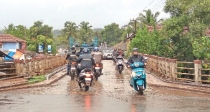
 Captured by : Agnelo Pereira
Old narrow bridge has become bottleneck, while traffic has increased in leaps and bounds
the goan I network
MAPUSA
The narrow width of the bridge has turned the crucial link, connecting several villages in Aldona to Mapusa town, into a bottleneck for vehicular traffic coming in and moving out of Mapusa. Besides, the wear and tear of the structure also raises several questions on the safety of
nt-size: 12px; font-family: "Lucida Sans Unicde", "Lucida Grande", Arial, Helvetica, sans-serif;">the bridge.
With new bridges now connecting Aldona to Bicholim taluka, many people from those areas prefer to take the Aldona route to enter Mapusa through the Tar bridge.
“Whenever there is a traffic jam on the main Mapusa-Guirim road, several commuters use this bridge and travel to Aldona or Panaji through the NH17 bypass. This has also increased the load on this bridge,” said a
local resident.
The bridge which is 20-metre long and just 3.5 metre wide was reconstructed more than 50 years ago. It is a vital link as it connects the densely populated areas of Aldona
to Mapusa.
The bridge is very narrow and allows only one vehicle to pass at a time. Almost always and especially during peak hours, there’s a long queue of vehicles on either side of
the bridge.
Some years ago, the Mapusa Municipal Council had banned heavy vehicles from using
the bridge.
“The number of vehicles using the Tar bridge has increased tremendously over the years. Now, it’s not the question of an option, building a parallel bridge across river Mapusa river is a necessity,” said Prakash Bhivshet, former councilor and resident from the area.
The Assistant Engineer of the National Highway A K Sadanand informed that around 22,000 vehicles commute through the Tar bridge
every day.
According to the assistant engineer, the completion of the ongoing underpass work at Bastora junction will definitely shoot up the number of vehicles entering Mapusa.
“The underpass will be a four-lane passage which will give smooth access to vehicles moving to and fro to Mapusa,” Sadanand said.
The Portuguese era bridge was destroyed by colonial forces when they were forced to retreat by the Indian army
in 1961.
Though the bridge was reconstructed on the same platform, officials at the Mapusa PWD have no records of when the bridge was rebuilt.
“After the Tar bridge was bombed by the Portuguese, the bridge was reconstructed somewhere in 1962,” informed former Mapusa MLA
Surendra Sirsat.
But Bhivhset begged to differ. He pointed out that the bridge was built by the Portuguese, which was only repaired by the Indian
government later.
“The bridge was built much before Goa’s liberation. It was partially destroyed by the Portuguese when they were forced to leave Goa. It was only repaired by the Indian government after liberation,” informed Bhivhset.


