MAPUSA
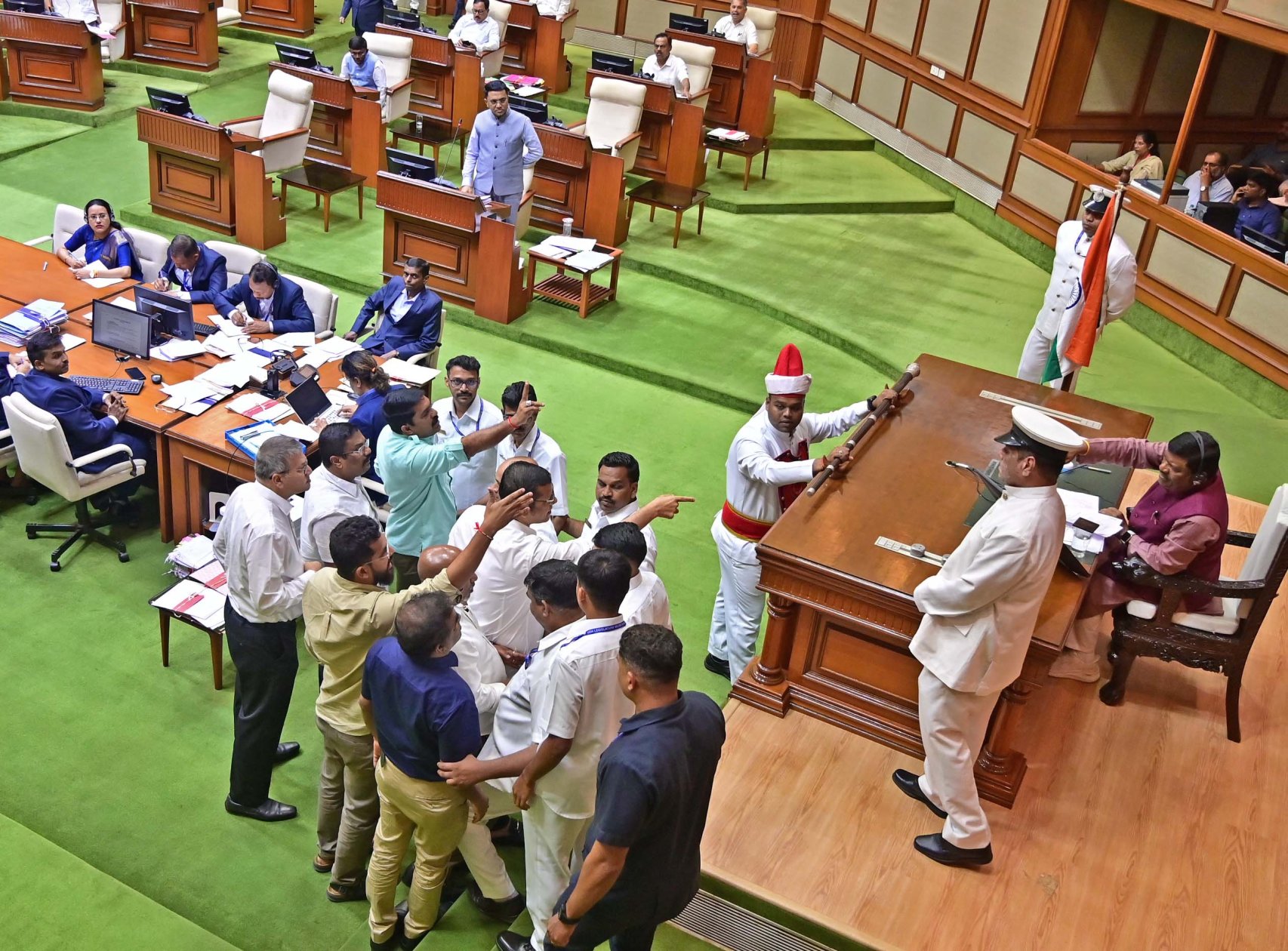
The issue of soaring electricity bills triggered repeated confrontations in the Goa Assembly on Wednesday, with Opposition MLAs storming the Well of the House at least three times demanding immediate relief for consumers, even as the government refused to budge from its position that Goa has the lowest power tariff in the country.
The heated discussion over rising electricity bills and the controversial rollout of smart meters spilled beyond Question Hour, with Opposition members accusing the government of failing to address the mounting burden on households.
Goa Forward Party MLA Vijai Sardesai led the attack, saying electricity bills had become a “huge burden” on consumers and questioning the government's decision to proceed with smart meters despite widespread opposition.
“People who have been getting Rs 600 bills per month in 2021 are today receiving bills of Rs 3,000 per month. Complaints of long billing cycles and increased rates have been pouring in. At the same time, the government was trying to introduce smart meters,” Sardesai said.
He also cited a statement made by the Union Power Minister in the Lok Sabha that consumers could not be compelled to install smart meters and sought to know whether the government would allow consumers to choose between smart and conventional digital meters.
Sardesai questioned the government's decision to put the smart meter rollout on hold after initially pushing ahead with the installation.
“If the system of fixing smart meters was going on properly, why did the government make a U-turn?” he asked.
Chief Minister Pramod Sawant and Power Minister Sudin Dhavalikar confirmed that installation of smart meters for domestic consumers had presently been kept on hold.
However, Dhavalikar made it clear that the government had no intention of scrapping the programme, saying Goa would eventually have to implement smart metering as it was mandatory under rules framed by the Joint Electricity Regulatory Commission (JERC) and the Central government.
“The CM has kept the smart meter installation on hold, but we cannot stop implementing it,” Dhavalikar said.
Sardesai hit back, saying the government should not “impose technology” on consumers and demanded to know what steps had been taken to actually reduce the tariff and ease the financial burden on the common man.
Dhavalikar said the government had already reimbursed Rs 32 crore recovered from consumers and urged households to opt for solar power as a means of reducing their electricity bills.
The government's response failed to satisfy the Opposition, with Leader of Opposition Yuri Alemao, RGP MLA Viresh Borkar and AAP MLAs Venzy Viegas and Cruz Silva repeatedly rushing to the Well of the House and demanding an assurance that consumers would be given relief.
Amid the din, Sawant rose to defend the government's power tariff policy, asserting that Goa continued to have the lowest electricity tariff in the country.
Sawant said consumers using up to 100 units were charged Rs 2.10 per unit, those consuming up to 300 units paid Rs 3.10 per unit, while consumption below 500 units was charged at Rs 4.15 per unit.
“If they show us any State with a lower tariff than ours, I will accept that rate,” Sawant said amid the Opposition protests.
The Opposition, however, continued to press the government over what it described as exorbitant bills being received by consumers, arguing that the issue could not be reduced merely to the per-unit tariff.
The repeated protests underscored the growing political battle over electricity bills, with the Opposition demanding immediate consumer relief and the government maintaining that the State's tariff structure was already among the most affordable in the country.