MARGAO
Saxttikars in particular and Goemkars have every reason to feel proud of the fact that the Defence Ministry and Directorate General, National Cadet Corps (NCC), have chosen River Sal, Salcete’s lifeline, to carry the river waters to the National War Memorial for Republic Day 2025.
Amongst the rivers in Goa, Commanding Officer, Goa NCC, Col Jesus Furtado, says with pride that River Sal has found favour with the Defence Ministry, given the river’s cultural and historical significance.
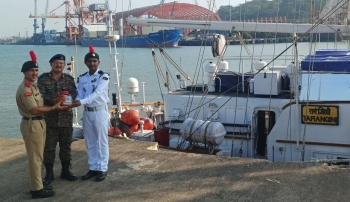
Thursday saw the naval ship INS Tarangini set sail from Mormugao Port with Col Jesus Furtado and 21 NCC cadets, along with a utensil containing the water from River Sal, on its onward journey further down south of India, before the ship covers the country’s east and the water collected from the rivers is flown to Delhi in West Bengal.
Back home, the government and its agencies, bodies including the Margao Municipal Council, the panchayats, and the MLAs representing the constituencies connected to River Sal, will have to grapple with the same old question “ when will River Sal, the lifeline of Salcete, be restored to its pristine glory? When can citizens expect the agencies to plug the rampant discharge of sewage water from the commercial capital into the river? How about the villages located on the banks of the river “ Do these villages any mechanism to treat the sewage and wastewater before it flows into the river?
Well, while recognition of River Sal for its historical and cultural significance may ring in good news for the people of Salcete, especially those inhabiting the riverbanks, right from Verna and downstream villages up to Betul where the river meets the Arabian Sea, the contentious issue of sewage disposal threatens the very existence of the river, degenerating the river into a stormwater nullah along the stretch passing through the commercial capital.
Rejuvenation of River Sal
Has the ambitious project to rejuvenate River Sal, launched with much fanfare and monitored by the National Green Tribunal (NGT), been taken to its logical conclusion? Or, is the River Sal rejuvenation plan stuck midway, with the rampant discharge of sewage into the river, from both the commercial capital and the villages, continuing unabated?

Sewage water gushing out of a stormwater nullah at the Old Market Circle.
Well, it’s now nearly five years since the Action Plan on River Sal was prepared by the government with the objective of restoring the river to its past glory, throwing up the moot question of whether River Sal can be rejuvenated without plugging the sewage discharge points along the Fatorda-Margao course of the river.
Questions have been further raised about whether the directions of the National Green Tribunal on the rejuvenation of River Sal have been implemented by the government in letter and spirit, and whether the directions have changed the ground reality.
In the order, the NGT had directed that the Action Plan should cover aspects pertaining to source control, industrial pollution control, channelisation treatment, utilisation and disposal of treated domestic sewage, river catchment/basin management/control, groundwater extraction and periodic quality assessment, flood plain zone, ecological/environmental flow (e-flow), and other issues that may be found relevant for restoring water quality to the prescribed standards.
HC directions
The host of directions issued by the High Court in the Salpem Lake Public Interest Litigation (PIL) goes to show that all is still not well vis-Ã -vis the rampant discharge of sewage in the commercial capital, which later finds its way into River Sal.
Be it the Margao Municipal Council, the Goa State Pollution Control Board, the Sewerage Infrastructure Development Corporation of Goa Ltd (SIDCGL), the PWD, sewage, and not to mention the South Goa Planning and Development Authority (SGPDA), these agencies have all received separate directions to play their role in order to plug the sewage disposal points.
The PIL was filed by Navelim citizen Prof Antonio Alvares in view of the sewage discharge in the commercial capital, before it flows into the picturesque Salpem Lake via the Kudchadkar stormwater nullah, leaving the water body contaminated.
In this respect, the Margao Municipal Council is further directed to inspect and check sewage discharge throughout its jurisdiction, and consequently take appropriate steps/measures/action within a period of 16 weeks from the date of the order and file an affidavit in compliance within two weeks thereafter.
The Court issued directions to the SIDGCL and PWD Division XXI to consider and take appropriate measures in terms of the recommendations made by the GSPCB, i.e., one, installation of a phytorid bed treatment system along the nullah flowing into Salpem Lake, and to establish in-stream treatment with phytorid bed.
“This aspect may be considered by the concerned respondents on priority, and an appropriate response be filed within a period of two weeks from today. In the meantime, SIDGCL may engage an advocate to represent them,” the court stated.