MAPUSA
In a rare show of unity, ruling and opposition MLAs came together to address the critical issue of the faulty sewerage system in Margao, which has led to overflowing sewerage chambers, health hazards and unbearable odours.
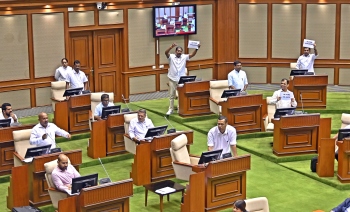
The matter was raised during the Calling Attention session of the Goa Legislative Assembly.
Margao MLA Digambar Kamat highlighted the gravity of the situation, describing how dirty water mixed with rainwater overflows from the sewerage chambers, contaminating properties and creating a stench.
“This is a serious problem that occurs during the monsoon season. Engineers have indicated a need to augment the sewerage treatment plant. The government should appoint a nodal officer to address this issue and find a solution,” Kamat urged.
Fatorda MLA Vijai Sardesai joined Kamat in expressing concerns, criticising the Goa State Pollution Control Board (GSPCB) for its recent actions.
Sardessai pointed out that officials had raided and issued notices to traders in the meat business, demanding they connect their outlets to the sewerage line or face closure.
“How can these businessmen connect their outlets to the sewerage line when there is no sewerage line passing in that area? Secondly, how can chicken or mutton waste be channeled through a sewerage line designed to treat human waste?” Sardesai questioned.
Adding to the debate, Curchorem MLA Nilesh Cabral noted that water infiltration into the sewerage line indicates a fault in the system.
“Appropriate steps must be taken to prevent this infiltration,” Cabral asserted.
St Andre MLA Viresh Borkar brought attention to the overflow and foul smell in prime areas like Patto, calling for strong measures to address the issue.
Benaulim MLA Venzy Viegas expressed concern about the sewerage discharge polluting the River Sal, emphasising the need for immediate action.
“This is a huge problem that will not get resolved soon. The government should take proactive steps to stop the discharge on top priority,” Viegas said.
Other MLAs, including Curtorim MLA Aleixo Reginaldo, Velim MLA Cruz Silva, and Leader of Opposition and Cuncolim MLA Yuri Alemao, also participated in the discussion, stressing the urgency of the matter.
Responding to the concerns, Chief Minister Pramod Sawant acknowledged the problem and assured the assembly that a meeting with concerned officials would be convened during the ongoing session to address the sewerage network issues.
Sawant informed the House that an additional 20 million liters per day (MLD) sewage treatment plant (STP) has been proposed by revamping the existing 7.5 MLD STP at Shirvodem, Margao. He noted that the sewage network in Margao and Fatorda is 35 years old, leading to significant infiltration and ex-filtration during heavy rains.
“The total wastewater, including rainwater infiltration received in both STPs at Shirvodem, is 41 MLD, which is far above the capacity of 26.7 MLD,” Sawant explained.
He also assured that the notices issued by GSPCB to meat traders in the Fatorda wholesale market would be reviewed.
As the government moves to tackle these issues, the unity displayed by the MLAs signals a concerted effort to address the critical problems affecting the sewerage system in Margao, aiming to improve public health and environmental conditions in the region.