


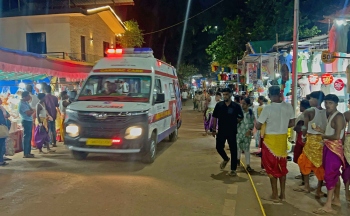
 An ambulance transports patients from the site of the Goddess Lairai zatra stampede in Shirgao. Captured by : The Goan/File photo
MAPUSA
The 2025 Shirgao zatra, a revered annual pilgrimage in honour of Goddess Lairai, will be remembered not for its spiritual significance but for the tragic stampede that claimed six lives and injured dozens of others.
As thousands gathered to take part in the ritualistic ‘dhond’ procession, what should have been a moment of devotion turned into a scene of panic and chaos.
Overcrowding, poor crowd control
Clearly, overcrowding and poor crowd control were the trigger that may have led to the tragic incident. The narrow access road to the temple, further congested by roadside stalls, played a significant role in the stampede.
Witness accounts and internal sources confirm that no proper barricading or emergency escape routes were in place “ elements that are critical to crowd management at large-scale events.
“The thought process was such that barricading would take more space and therefore it should be avoided. We thought that the dhonds/devotees would self-regulate and everything would go smoothly, which was probably wrong on our part,” admitted a member of the Devi Lairai Devasthan Committee on condition of anonymity.
Responsibility, governance failures
While the district administration must share accountability for the lack of oversight, the Devi Lairai Devasthan Committee “ an elected body responsible for temple affairs “ failed to enforce critical safety protocols.
One major area of concern was the decision to allow commercial stalls along the pilgrimage route, severely restricting space for pilgrims.
“There was a difference of opinion within the committee. Some members believed locals should be allowed to do business during the zatra,” the same committee member revealed.
The situation worsened because of alleged collusion between some members of the local panchayat and stall owners, where permissions for additional stalls were reportedly granted in exchange for money.
"We allowed certain stalls along the route. But some panchayat members gave further permissions for a price, which added to the chaos,” the committee member alleged.
Ignoring precedents
Former temple committee president Ganesh Gaonkar disclosed that during his tenure, barricading had been introduced for the first time and successfully implemented over two years.
“Things went smoothly when barricading was in place. But the current president opposed the idea. Last year, there were no barricades either, but we managed because we took other precautions,” Gaonkar said.
These precautions included public appeals to avoid crowding on the main zatra day, allowing for darshan in the days leading up to and following the event. However, these measures were abandoned by the current leadership.
“This tragedy could have been avoided if the current committee had sought advice from former office-bearers and continued the tried-and-tested crowd control measures,” Gaonkar added, squarely blaming the present leadership.
The Shirgao zatra stampede of 2025 stands as a tragic reminder of the consequences of neglecting safety in mass religious gatherings.
While devotion fuels such festivals, planning must be rooted in logistics, foresight, and public safety.
Going forward, all stakeholders “ administrative, religious, and civic “ must work in unison to ensure that faith never again becomes a casualty of mismanagement.


