


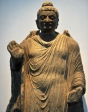
"It's there," says an archaeologist pointing tothe ground, where fragments of a Buddha statue from the ancient Gandharacivilisation have been covered up to stop them being stolen or vandalised. Justmonths before the US-led invasion in 2001, the Taliban regime shocked the worldby destroying two giant, 1,500-year-old Buddhas in the rocky Bamiyan valley,branding them un-Islamic. More than 10 years on Western expertssay Afghanistan's ancient Buddhist and early Islamic heritage is littlesafer.
At the foot of the cliff where the two Buddhas used to stand130 kilometres west of Kabul, an archaeological site has been found and partsof a third Buddha, lying down, were discovered in 2008. The area of the lyingBuddha is around half the size of a football pitch. A dozen statues or more lieunder tonnes of stone and earth.
"We covered everything up because the ground is privateand to prevent looting," says Zemaryalai Tarzi, the 75-year-old Frencharchaeologist born in Afghanistan who is leading the project. Tarzisays he dug first in the potato fields to find artefacts, which he buried againafterwards. All around him, under a large area of farmland, he says, lieexceptional treasures. In the West, the presence of such riches would lead to alarge-scale excavation, frantic research and in time, glorious museumexhibitions.
In Afghanistan, ground down by poverty and threedecades of war, it is the opposite. "The safest place is to leave heritageunderground," says Brendan Cassar, head of the UNESCO missionin Afghanistan, adding that policing the thousands of prehistoric,Buddhist and Islamic sites dotted around the country was impossible. Belowground, the relics are protected from endemic looting, illegal smuggling andthe corrosive effects of freezing winters. Archaeologists complain that cultureis only a secondary consideration to development and security.
A meeting in Paris last year decided one of the two nichesthat housed Bamiyan's giant Buddhas should be left empty as testimony to thedestruction, while experts should look at partially reassembling the otherstatue on site.
But local archaeologist Farid Haidary says "lots ofmoney" was spent on restoring the Buddhas before the Taliban destroyedthem. "What's the point in building something if the Taliban, who are 20kilometres away, destroy it afterwards?" he asks.


