


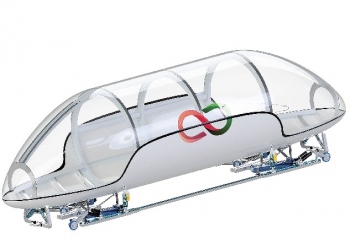
The young engineering students in India are at work, trying to make a high speed vehicle which works on the principle of magnetic levitation designed to carry people at speed of around 1000 km per hour. In a one of a kind competition in the world, where the fifth mode of transport (apart from the current road, rail, water and air) will be a reality, young masterminds from India are participating in August 2017.
The eight students from BITS Pilani Goa campus who will be among the team are Dhruv Mahajan, Harikrishnan R Unnithan, Sairaj Khope, Sreejith Pisharody, Vinambra Bhatiya, Utkarsh Sarawgi and Kartik Kulgod. The initial team has now expanded, and has included the best engineering minds from engineering and business schools of India - BITS Pilani Univeristy, IIM Ahmedabad and Indian School of Business, National Institute of Design, R V College of Engineering and St Xavier College (Mumbai).
"We have built a prototype of hyperloop-like travelpod which can travel at 1000 km/hour. We will be testing this soon. Our pod is going to run in a one-mile long vacuum tube at SpaceX headquarters at California," says an eager and excited Sairaj Khope. A third year engineering student at BITS Pilani Goa campus pursuing BE (Hons) in Electronics and Instrumentation.
Sairaj, also a member of the University-wide team that worked on building the hyperloop pod in India for the competition, is leaving for US on August 15 with 18 other team mates. There are 10 non-testing members too. The team is the only Indian team that has been selected in the top 24 finalists who would compete with each other with their pods.
"During our two month working period, we were supported and mentored by experts in infrastructure, logistics, transportation and data collection from Workbench Projects, Hyperloop One and many others. We are grateful to persons like Pavankumar, Anupama Gauda and Jitendra Dauda who mentored and advised us at various stages of our work. They offered significant support in building the pod," recalls Sairaj.
This new transportation system needed to be safer, faster, lower cost, more convenient, immune to weather, sustainably self-powering, resistant to earthquakes, not disruptive to those along the route. Is there truly a new mode of transport - a fifth mode after planes, trains, cars and boats - that meets those criteria and is practical to implement? Initially, it was just an idea that was floated by Tesla CEO Elon Musk in 2013. After catching attention from the media and the community, it got momentum. Now with pods ready for testing, the dream concept is only a few steps away from turning into a reality.
Team Hyperloop India required Rs 30 lakh to build the pod prototype and make it to California for the final contest which they managed to raise through crowdfunding. "We raised funds through crowdfunding campaign and Team Reflexes from US (BITS alumni) sent us 12500 dollars. The amount raised by crowdfunding was Rs 35.8 lakh when the campaign ended on August 9," states Sairaj.
"The manufacturing process of our pod happened at Ripple Technologies in Bangalore where Miracle Electrical Devices helped with the entire electrical and electronic testing and assembling," says Sairaj, 20.
The initial team expanded and included the best minds from top engineering and B' schools of the country including BITS Pilani University, Indian School of Business and IIM Ahmedabad.
The students are supported and mentored by experts in transportation, logistics, infrastructure and data from organizations like Hyperloop One, MapmyIndia, SKF, Start-up India, Invest India, Workbench Projects, RITES, BMRCL, Jindal Aluminium, Peenya Industries Association, NITI Aayog, Ripple Technologies and DP World India.


