Grace C Roberts
Around the world, virologists in labs are constantly handling samples of SARS-CoV-2, the virus that causes Covid which we already know is highly infectious and can even be lethal. This is nothing new. Virologists regularly handle large quantities of virus in much more concentrated forms than we would encounter in the outside world. So how do they stay safe from these pathogens?
Procedure and protocols
Before anyone gets near new viruses, they need permission from the relevant government authority and must demonstrate that they can work with it in a safe and secure environment and carefully document everything so that everyone stays safe.
This includes using specialist screw-top lids to store virus samples to prevent spills, and treating all liquids in the facility as infectious “ even if it’s a newly opened bottle of sterile water.
Scientists who work on hazardous viruses have also undergone significant training. This includes academic qualifications and laboratory experience, but also specific instruction in handling pathogens safely.
Equipment
A lot of the physical protection from the viruses we work on comes from the environment in which they are handled. There are separate rooms for virus work and non-virus work to prevent contamination.
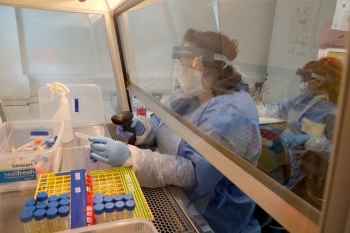
Hazardous viruses are handled in specialist cabinets that have controlled sterile airflow. This protects the user from the pathogens as air is restricted from leaving the cabinet, and protects samples inside the cabinet from the user. There are many microbes in the air and on our skin, and we don’t want experimental samples getting contaminated with any of these.
In higher containment facilities, like those used for SARS-CoV-2, the entire room is maintained under negative pressure “ the air pressure inside the lab is lower than the air pressure outside it.
No air can leave these rooms without going through a specialist filter that removes potential pathogens.
Cleaning
A large amount of virology revolves around cleaning up. Cabinets are cleaned with alcohol before and after use, as is anything taken in or out of them. In addition to cleaning surfaces, anything used inside virus labs must be disinfected before removal. All tubes, flasks and so on are chemically disinfected and then cleaned with an autoclave “ an industrial sterilisation unit that uses high pressure and temperature to remove pathogens.
As an extra precaution in higher containment facilities, regular fumigation is performed where the entire room is sealed and pumped full of formaldehyde gas to neutralise any lingering pathogens.
Personal protective equipment
This is the final barrier of protection. If protocols are followed and equipment used correctly, there should be no instances of a lab user being exposed to a virus sample. Unfortunately we cannot foresee all incidents and scientists are only human, so PPE is crucial to safe lab work. PPE also protects our samples from the microbes and enzymes on our skin.
In labs handling mild risk pathogens, scientists wear lab coats and gloves (sometimes also eye protection where necessary). Pathogens are unlikely to leave the cabinet but if they do, they would only cause mild illness to healthy individuals so no more PPE is required.
Working in higher containment where pathogens are more likely to be transmitted or cause more serious illness (or both), significantly more PPE is used. Rules in these facilities vary as they are tailored specifically to the pathogens handled, but in general, full biohazard suits are worn which are sealed at the ankles and wrists. Specialist footwear is worn, gloves are doubled up (in case one layer of glove becomes compromised).
For viruses such as SARS-CoV-2 that infect the respiratory system, goggles and FFP3 masks which are specifically fitted to individual users are worn to protect from exposure via inhalation or through the eyes. All these items of PPE are worn so that, in the unlikely case of a spill, workers have time to exit the facility without exposing themselves to infection.
It all comes down to responsibility
No matter the pathogen, regulations, or set-up of a laboratory, our main form of protection from viruses is the scientists themselves. Everything discussed in this article is only effective if every scientist in the lab follows all the regulations and has the right training.
There is little point donning all your PPE if the person who used the lab before you did not follow procedure “ for example, if there was an unreported spill or a used scalpel blade left out on the benchtop. It is up to all of us to keep ourselves, our colleagues, and the outer world safe.
This ethos is also relevant to our daily lives during the pandemic. It is important to notify the lab of spills in the lab, just as it is important that we report Covid symptoms or a positive test result. It’s important that we leave our lab space clean and tidy for other uses, much like it is important to regularly wash our hands. It’s important we wear PPE in the lab to protect ourselves and our samples, much like we need to wear masks properly to protect those around us in public.
Finally, like in the lab where we treat any and all liquids used in the virus facility as infectious, in the outer world we must treat ourselves and those around us as potentially infectious at all times. If we want to beat this pandemic, we all need to think a little more like virologists.