Atika Modassir
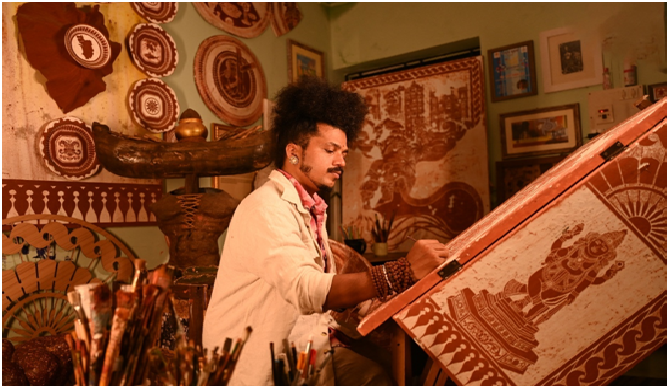
What if Goa’s ancient paintings were never really painted at all? No brushes dripping with a rainbow of colours, no canvases stretched out on easels, no smell of oils or chemicals but just the smell of wet earth, seashells and sand wafting through. Ages ago, rust red and sparkling white colours told tales of folklore and veneration on lime plastered walls of sacred temples. Originating from ‘kaav’- earthy red in Sanskrit, Kaavi kalé is an artistic wall mural tradition characterised by graphic etching. Lime plaster coated with red laterite pigment is carved upon by the artist to reveal contrasting white patterns of shell lime that come alive by scraping the surface with custom made steel and wooden tools. Kaavi - Goa’s very own art form born of its laterite soil has weathered not just the centuries old currents of monsoon, but also of colonial rule. As Hindus fled The Inquisition, they took the art along the Malwan, Konkan and Malabar coasts. This also led to broadening its imprint on churches and mosques, beyond temples, ancestral homes and shrines. The resulting designs took on a unique indigenous depiction incorporating European ecclesiastical imagery and Western Asian geometry and floral motifs. Combined with ethnic Indian symbols of mythology, lotus flowers, mango leaves and more, these influences have rendered it distinct from other Indian folk art like Warli and Madhubani. The exodus of Hindus, followed by the subsequent introduction of modern paints led to its waning in the course of time. Recent preservation, protection and documentation efforts by bodies such as Indian National Trust for Art and Cultural Heritage, Goa Heritage Action Group and the Charles Correa Foundation; as well as its introduction in the Goa Education Board’s art syllabus have given it fresh impetus. In an increasingly concretised landscape, kaavi’s use of natural and sustainable materials for climatic adaptation lends it with fresh significance. The process requires no mechanisation and is elemental; using local hand pounded lateritic soil, river sand, burnt seashells, jaggery, lime putty and riverbed pebbles for polishing. It also provides momentum to Goa’s image as a cultural destination by spotlighting its historical Konkan heritage. Kaavi kalé is commonly likened to the European Renaissance sgraffito technique, due to the process of engraving a coloured surface to reveal an underlying layer beneath. It is different though as it requires only soil pigment and seashells to create a duo-chromatic impact; versus needing a multiple of coloured plaster layers to produce a multi-chromatic effect. Moreover, being a practical local innovation for climate-responsive craftsmanship, Kaavi goes beyond being simply an artistic ornamentation style.
Providing momentum to the artform in recent times, is a young son of the soil- artist Sagar Naik Mule. Growing up immersed in the folk-art culture of his village Adpai, he began experimenting with soil and cow dung; inspired by his love of nature and ethnicity. During the covid pandemic, Sagar demonstrated his flair for turning adversity into good fortune by fostering a commitment towards kaavi kalé. With an ingrained love for tradition his home turned into a studio of living art. Reproducing scenes from the Ramayana, Mahabharata and the Hindu pantheon, Sagar revived the art with the images of divinity created from the ochre ground beneath his feet. His artwork gained prominence at the G20 Energy Ministerial meeting held in Goa in 2023, followed by the Goa Statehood Day Award, a mention in the Prime Minister’s radio broadcast and a recognition of his efforts by being named Artist-in-Residence at the Rashtrapati Bhavan. He also features in an issue of Amar Chitra Katha as an example of a self-made artist; providing inspiration to children about how anyone who loves art can create it. Disregarding the common notion of art as an elitist bastion, he emphasises that nature is his art gallery and the soil is his canvas. His journey from the grassroots to national recognition is marked with a latent appreciation of Indian culture, devotional observances and community spirit. To Sagar the value of land does not lie in property prices but in the nourishment, it provides to all living beings. Based on his own experience, he is a strong advocate of grounding ecotherapy and believes that contact with soil helps surmount the stress of modern life and promotes better physical and mental health. As I heard him share his passion for our ochre earth I could see that more often than not in life; less is more. Just as Sagar chips away at a coloured surface to unearth a pure white core, the simple act of peeling away our notions of the self can reveal the beauty within. An innate beauty that is born from simply being -no embellishment needed.
(The writer is a Human Capital Strategist and Educationist; meaning she invests in humans like blue chip stocks and teaches them how not to crash the market)