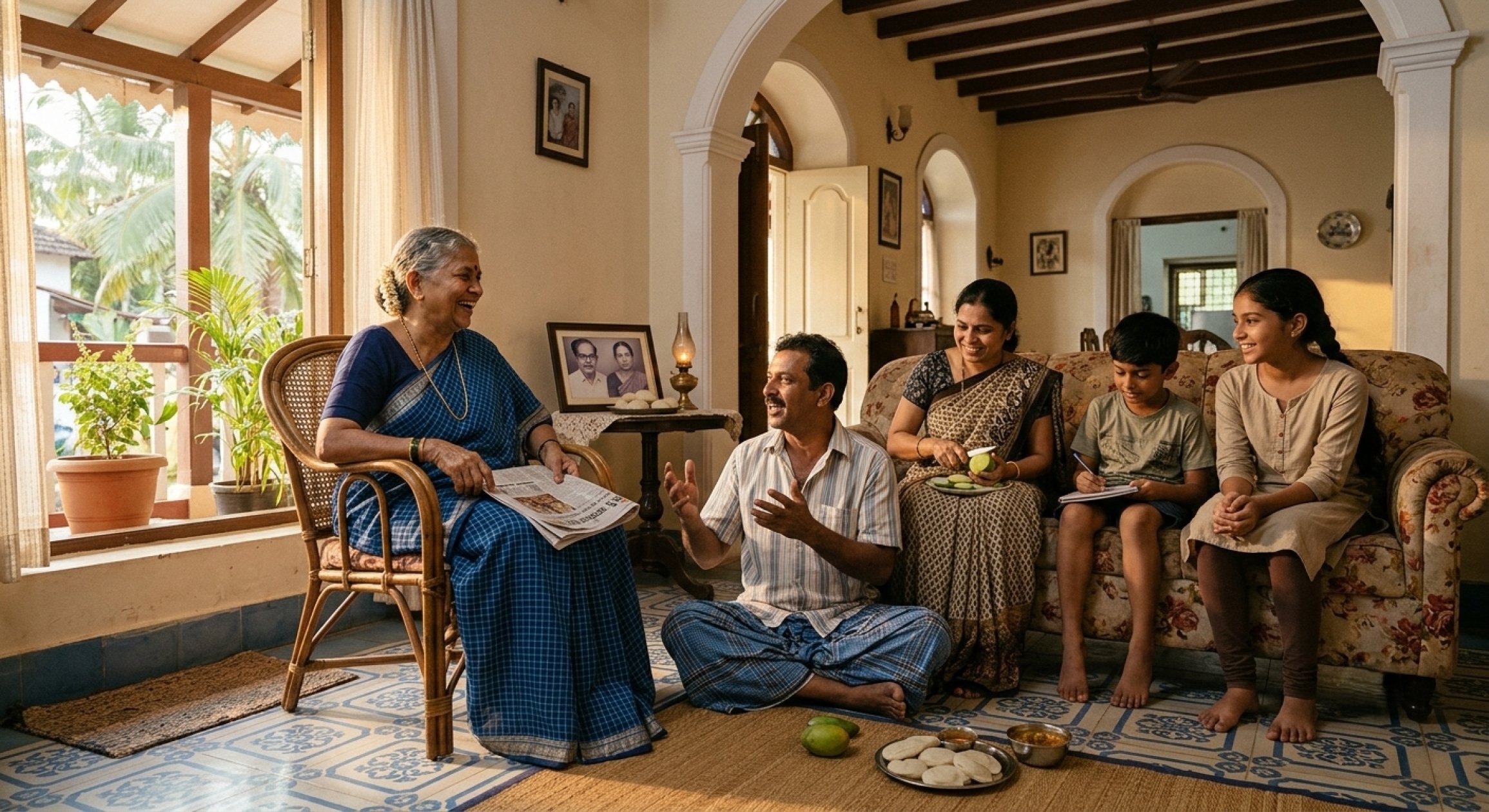
The child usually learns English nursery rhymes at school, watches Hindi cartoons with friends, and hears a dozen languages around him. But when it is time to sleep, he turns to his grandmother for the familiar Konkani lullaby he has grown up hearing. As the state continues to welcome people, cultures and languages from across the country, Konkani holds on firmly to its roots. The language is strongly woven into homes, families and the reason Goa attained statehood.
Changing identity
The way people use the language is changing and so does the question of what it means to be a Konkani speaker in Goa today. Yet these ordinary conversations raise a larger question about Konkani: is knowing the language enough?
Uday Bhembre, an advocate and writer, recalls how the events played out in 1987, during Goa’s fight for statehood. “When the Bill was passed in 1987, the number of Konkani speakers was reported to be about 95%. In fact, that is one of the main reasons this was declared as wanting to be a separate state,” he mentions. “Indeed, if you know Konkani and you call it your mother tongue, you must speak it and speak it proudly,” remarks renowned writer Damodar Mauzo adding further, “We Goans have a bad habit of thinking less of our language and culture, but that shouldn’t be the case. Konkani is equally important and needs to be spoken with the same pride,” he states.
Growing languages
Bhembre explains that the number of Konkani speakers has not exactly declined. “In the 2011 census, it was 70%, but those numbers do not mean that the speakers have become fewer; those who speak Konkani have held on strongly to it. However, speakers of other languages have increased in Goa,” he remarks. Mauzo also points out the Konkani population that is living in the neighbouring states. “Often they do not say that their language is Konkani, for whatever reasons. In Karnataka they put their language as Kannada. They often hesitate to put it as Konkani,” he explains.
Konkani is not simply a mother tongue, points out Mauzo. “Konkani is not the mother tongue; rather, it is the language of the soil that we are born in.” He adds that, beyond being the identity of the state, it must be encouraged and carried forward. “When we say Goa, Konkani automatically comes along with that,” remarks Serafino Cotto, President of Konkani Bhasha Mandal. Its place extends beyond the state too. “If you look at a Rs 10 note or a Rs 50 note, the sixth line will be ‘dha rupya’ or ‘pannas rupya’ in Konkani. Which means that the Konkani language is placed of equal importance with all the other languages,” he explains.
Growing languages
That connection with the soil may also explain why many people who come to Goa eventually find themselves speaking Konkani. Commenting on the influx of non-Konkani speakers who often go on to speak the language fluently, Bhembre says, “It is a good thing in a way, maybe, since they use it, which is helpful for everyone. Mostly they learn it by hearing, and since even going to the market requires you to speak Konkani, they often pick up the language.” Mauzo adds another observation: “We Goans also have this habit of shifting to the language the person in front of us is speaking. If they speak Hindi, we speak Hindi; thus, those speaking with us also tend to pick up our language.”
But while newcomers may be picking up Konkani through the everyday rhythm of life in Goa, Bhembre and Mauzo emphasise that encouraging the language among Goans themselves requires a more conscious effort. For them, educational institutions and parents have an important role to play. “Often some of the convent schools make it mandatory for the students to speak English. While learning English is fine, if we are truly foresighted, we need to make sure that we don’t lose our identity in the process,” Bhembre says. Otherwise, he adds, it can lead to deculturisation, as a language also carries with it a culture.
School memories
Cotto recalls a similar experience from his own school days. “We had a rule at that time, where we were told to speak and converse with each other only in English,” he says, adding that students who disobeyed were fined four annas or two annas. “It never sat right with me. Now, while I understand it is important to learn English, living in English and leaving Konkani is not what we should encourage as Goans,” he states.
Goa today speaks in many languages, and that in itself is part of the state’s changing character. But alongside them, Konkani continues to hold its own. The language has not been left behind, nor has the arrival of new speakers meant that its own speakers have disappeared. Still, preserving a language goes beyond simply knowing or speaking it. It lies in choosing to use it, pass it on and give it the pride it deserves. For a language so deeply connected to Goa’s identity and statehood, that responsibility now rests with the generations that will carry both forward.