Atika Modassir
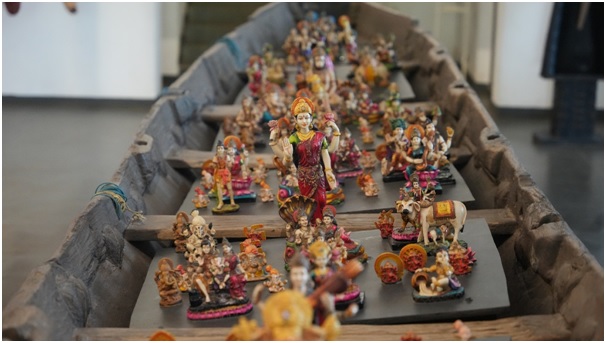
MOG means love in Konkani - and the Museum of Goa (MOG) speaks to Goa’s collective love for storytelling and contemporary art by lending a modern voice to our traditions. Established in 2015 by Dr Subodh Kerkar, MOG invokes Goa’s identity beyond photographs and travelogues; it brings forth the preservation of cultural memories, making them accessible to all. While narratives the world over tell us about how God saved mankind, only in Goa will you hear about how man saved God. A 500-year-old historical deed of the Adpai boatmen, memorialised as an artwork – in ‘Goa’s Ark’ (Dr Kerkar) – exemplifies Goan devotion and resilience.
Art narrates history in a language of its own and the ‘Goa Diaries’ (Mhamal) presents a time capsule of Goan history, through journal-like illustrated folios. A pictorial chronicle of 32 paintings, it acknowledges milestones ranging from the geological formation of Goa, liberation and the advent of modern industrialism, thus tracing the turning points and transformation of the land.
HOMES THAT HOLD TIME
While history is commemorated through major milestones, it also layers softly over the walls of our homes. ‘150 Natals’ (Dr. Kerkar) delicately unveils the passage of time through the layers of paint on a 150-year-old family home. Displaying the tradition of painting homes for Christmas, it reveals the 150 coats of lime the Gomes home has worn through the years. In accordance with the conventions of the time, it was white for the first 30 years, indigo for the next 40 years, followed by red oxide and then yellow ochre for the last fifty years.
Just as walls can preserve the memories of personal histories, windows reveal how a society engages with the world beyond home. Much like the eyes that are the windows to our souls, the character of a traditional Goan home is reflected in its windows. Much more than their function, they are symbols of centuries of cultural amalgamation reflected in the architecture of traditional Goan homes. ‘Goan Windows’ (Dr. Kerkar) showcases the windows of four homes representing this heritage, through the best of local craftsmanship in designing wooden shutters, oyster-shell panes and glass panel frames. Together, these works define the most intimate aspects of Goa’s domestic architecture.
PEPPER, TRADE AND TURNING TIDES
While our built environments relate how people lived, our habitat is also shaped by the forces of exploration and economics. The Pepper Boat (Dr. Kerkar) sails beyond our homes and seaward, recounting the story of how a nondescript spice launched fleets across the Arabian Sea. The pursuit of this ‘Black Gold’ fuelled European maritime ambition, bringing the Portuguese to Goan shores in the 16th century. A telling reminder of how the power of a humble kitchen ingredient changed the map of Goa and the course of history.
MANY MEANINGS OF MANGOES
Through summer, MOG presented ‘Mangoes & Meanings: Histories, Ecologies and Cultural Imagination’, which celebrated the mascot of the Indian summer through the works of over 40 artists, portraying the mango as an experience that binds a nation. If you’ve travelled on Indian motorways, you’ve certainly noticed the prominent, street-graffiti-style-inspired painted signs on lorries. Ahmed renders the commonly displayed phrase All India Permit in multiple Indian languages on the canvas, alluding to how no other fruit has the permit to hold India’s imagination like the mango. Closely woven across cultural narratives, it transforms into a symbol of prosperity, vitality, abundance, and luck in various Indian traditions and features across cuisines, sweet or sour. It finds its way as an auspicious symbol in homes, temples, and wedding venues; and, representing good fortune, it features in traditional design across art and ancient architecture.
This spirit of transformation finds a more personal expression through a man who reimagined what a single mango tree could become. Dasgupta pays homage on canvas to Padma Shri Kalimullah Khan, the Mango Man of India. A self-taught farmer from UP, Khan pioneered grafting techniques through which a single tree bore more than 300 varieties of mangoes. Every fruit on the branches portrayed teaches us the lesson that honing extraordinary skill can forge a partnership with Mother Nature to bear fruit for all.
While Dasgupta applauds human ingenuity, Kudnem (Morajkar) reminds us how patience nurtures our dreams, making life itself possible. A mango takes shape as a woman’s heart and the keeper of her silent longings, as she waits stoically. In contrast, a monkey by her side grabs for a mango with hardly a worry. It echoes that while we have emotions in common with other living beings, what differentiates us from the rest is that pregnant pause before impulse takes hold over action.
ART AS A SHARED ETHNOSCAPE
COO and curator, Sharada Kerkar, says, “We believe that art is the universal language of mankind and has the power to connect people from all over the world. Apart from taking contemporary art to the larger public, the museum is also a pedagogical experiment in narrating history”. Like waves that caress Goan shores and seasons rejoining the mango tree, sagas flow through artistic expression. You leave carrying remnants of journeys and lifetimes across shared ethnoscapes that shape you.
(The writer is a Human Capital Strategist and Educationist; meaning she invests in humans like blue-chip stocks and teaches them how not to crash the market)