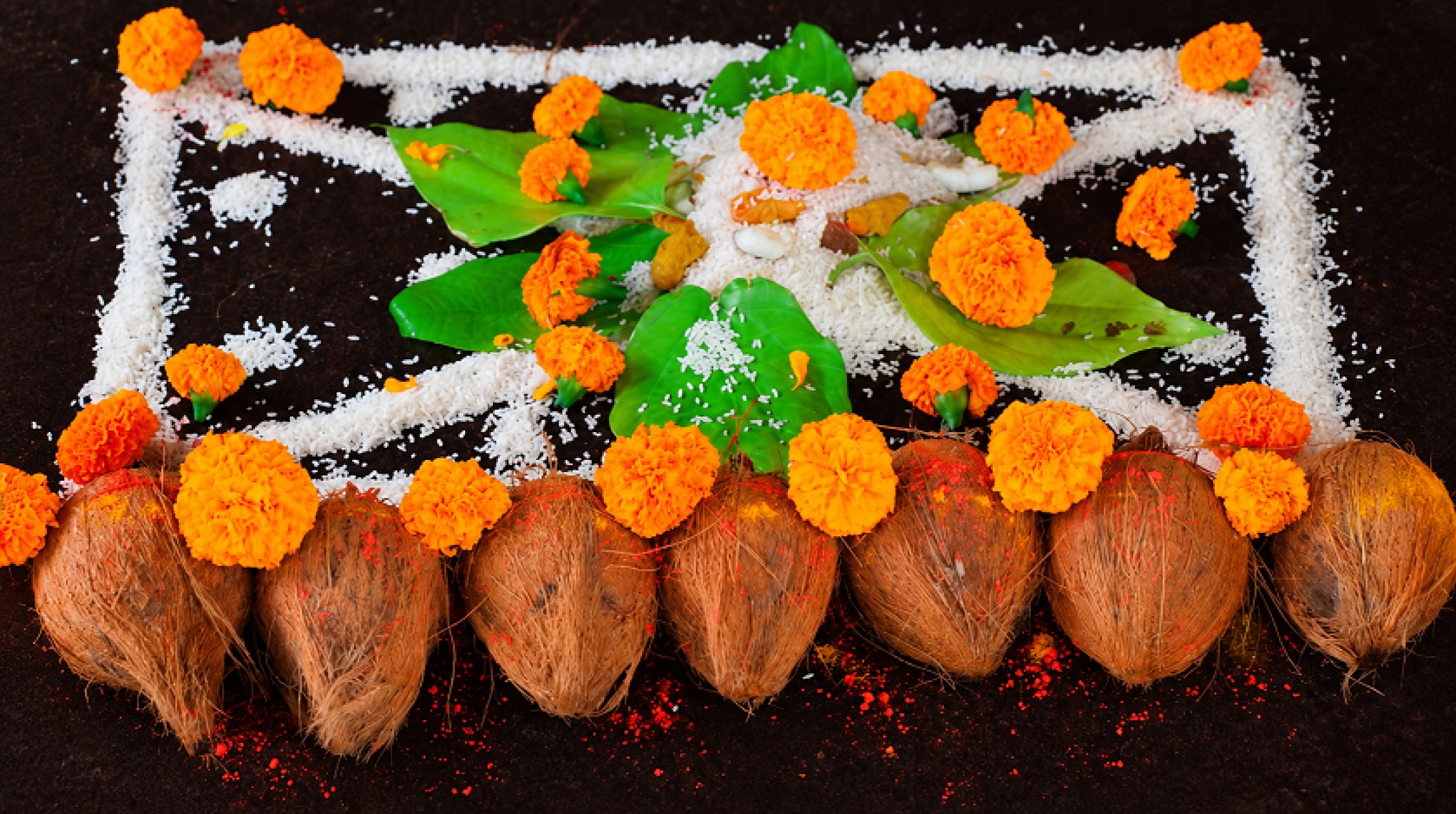
 A Pud, a traditional ritual offering worshipped by the Dhangar community on the seventh day of Navratri, adorned with coconuts, marigolds, leaves and rice as part of their age-old customs.
Across Goa, communities have their own ways of celebrating Navratri, with rituals shaped by local customs and beliefs. Among the Dhangars, the festival brings together the worship of clan deities, offerings made from natural materials and traditional folk performances. Living across the hilly regions along the Goa, Maharashtra and Karnataka borders, the community has a long pastoral history, reflected in several of its customs.
Ritual offerings
In the local observance described by community members, the seventh day of Navratri is marked by the worship of the ‘pud’. A mandapi or matoli is erected over it using betan or chivare wood. A toran of five coconuts is tied to the structure, while flowers, fruits and vegetables, including cucumbers and lady’s fingers, among others, are tied using a strong thread. The arrangement brings seasonal produce into the place of worship, making it an important part of the ritual. The community also worships its clan deities. In the Tilari area, basaltic stones known as tandale and metallic symbols called patawa are worshipped as representations of the deities. According to local accounts, these sacred objects are washed with ghee and milk before being placed on Karmal tree leaves and, on the following day, on khauche paan. The rituals form part of the community’s observance of Navratri and its traditions of deity worship.
Music and dance
Navratri also brings the Dhangars together through music and dance. The community’s celebrations extend into Dussehra, with the three-day observance traditionally known as Zagor, Dossro and Shilangan. During Zagor, community members gather for worship and traditional performances. They have a saying, ‘Har Bhala’ and ‘Chaang Bhala’, meaning let good happen to everybody and let good things happen everywhere.
There is no known origin of this ritual, but it has been passed down across generations. Men dressed in white jhago and turbans perform Gaja nrutya, accompanied by drums, brass plates and bamboo flutes. The dancers visit households, bringing the celebrations into the community. The performances are closely connected to the Dhangars’ cultural identity and provide an occasion for families to come together. However, the dances are not limited to men. Women too perform dances as they go around in circles to the beat of the music, often singing local folk songs.
Traditional practices
Other rituals include ‘Eka taatath nevaidye khavpache’, the practice of sharing naivedya from one plate, and ‘Talwari khel’, a traditional swordplay performance. ‘Taak angaar otap’, a ritual involving buttermilk, is also observed. During these festivities, a garane, that is, prayers, is offered to the nature deity for the well-being of the world and society. These customs accompany the worship and festivities, with specific practices that often vary between settlements. The celebrations culminate in Shilangan on the tenth day of Navratri. Families gather for worship and offerings, followed by the distribution of prasad among community members.
Living traditions
While the rituals may differ between settlements, they remain closely linked to the customs followed by Dhangar families over generations. The use of seasonal produce, worship of clan deities and folk performances offer a glimpse into a form of Navratri that is distinct to the community, with its own practices and traditions continuing alongside the festival’s wider celebrations across Goa.