Atika Modassir (Oxon)
For The Goan
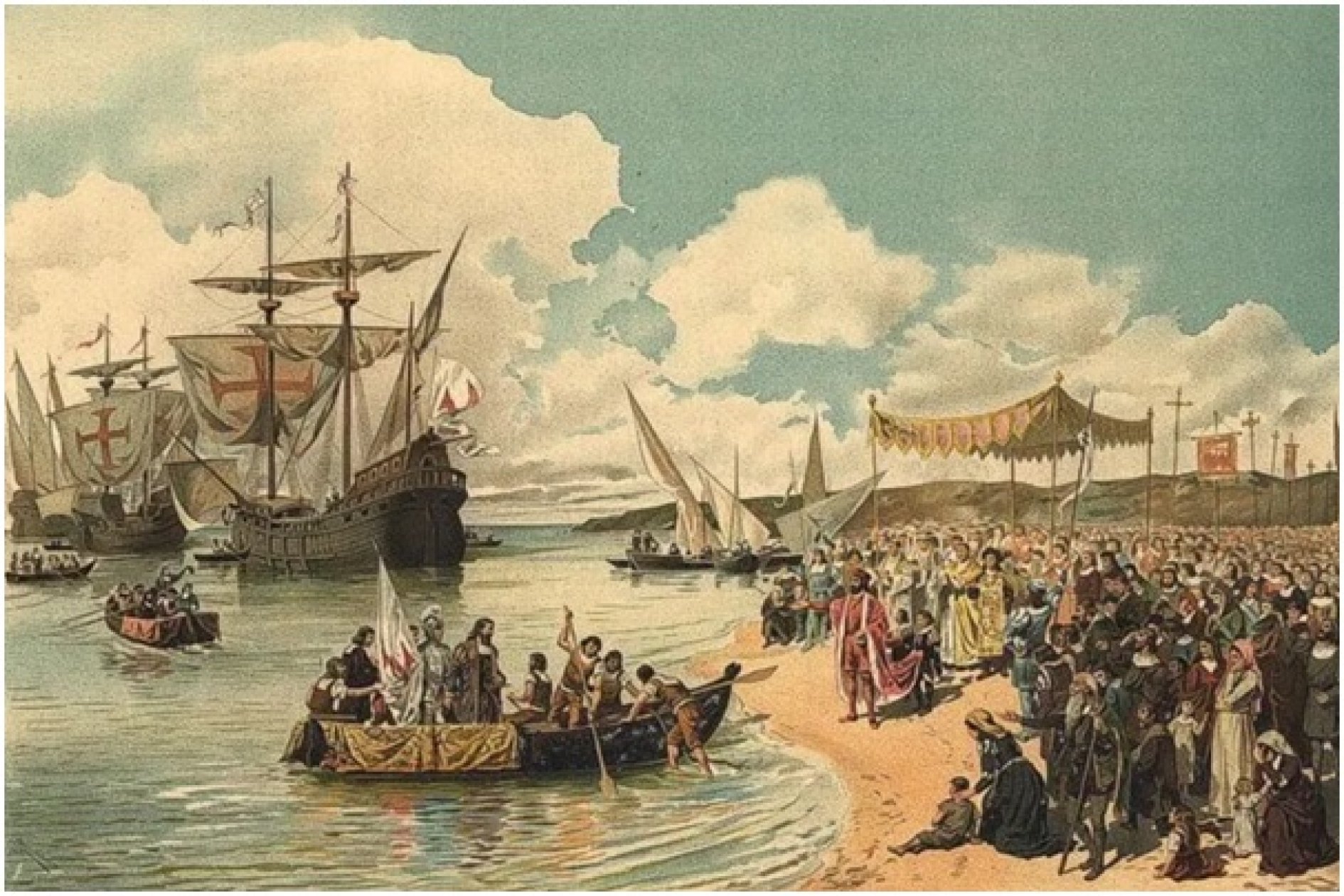
It was Saturday, 8 July 1497. Vasco da Gama attended Mass at Restelo and left home as his fleet sailed down the Tagus, into the Atlantic Ocean. They steered into an uncertain future towards oceans exotic, fortunes unknown and glories unseen. The adventure culminated on May 20, 1498 when they dropped anchor off the shores of Calicut, accomplishing the first direct sea voyage from Europe to India. It changed not just Vasco da Gama’s fate, but also Goa’s place in history, as the cynosure of Portuguese ambition for Asia. As Lady History is generous to her heroes, she crowns one man, her gaze lingering on him, casting him in a golden spotlight while the rest fade into the shadows. So, it was with Vasco da Gama. Our story looks beyond the spotlight, at the steadfast ships and the unsung sailors who made that historic voyage possible.
Portuguese maritime ingenuity was exemplified in the sea-faring vessels they built. An agile exploring vessel, the caravel could reach very close to the coast in shallow waters. Built for manoeuvrability, it had a low load capacity with approximately 50 people. It could negotiate against the wind with its triangular lateen sails. Its big sister, the carrack or nau, was meant for intercontinental sailing. Much bigger, it had mostly round-square sails and carried roughly 200 people along with supplies and armaments. A floating fortress, it bridged the oceans for war and trade while the caravel explored the coasts, unhindered.
By the time Vasco set out, the Age of Discovery was well on its ascent, extending to the 17th century. He commanded his carrack São Gabriel; his brother Paulo da Gama captained the carrack São Rafael; with the caravel Bérrio and São Miguel, a supply ship (navio de mantimentos), completing the fleet. The fleet bypassed the old routes dominated by Arab, Persian and Mediterranean traders and charted a course to one of the busiest Indian Ocean ports. There Vasco discovered not just riches of gold, ivory, spices, textiles and gems, but cross-cultural prosperity arising from centuries of commerce between merchants from Malabar, Gujarat, Arabia, Persia, East Africa, Egypt, Sri Lanka and Southeast Asia. It heralded a new era of global commerce and the establishment of the Portuguese Estado da Índia, of which Goa would subsequently become the permanent capital.
While history lauds Vasco, he certainly could not have made it far without his crew. The fleet was not just an armada, but a floating village. Cabin boys (grumetes) kept long hours of hard drudgery, chaplains (capelães) kept the sailors righteous and spread Catholicism to new lands - as the expedition was seen not just as a commercial enterprise, but as a holy crusade by the Crown. There were doctors, tradesmen - carpenters to fix the ship’s timber and caulkers to mend its seams, while the cook (cozinheiro) took charge of rations and communal meals. He had a gruelling and dangerous job owing to the fire hazard of operating the ship’s kitchen (fogão). Also onboard were administrators and the scribe (Escrivão), who was one of the most powerful and feared figures appointed by the King as an independent auditor, holding financial and legal authority. While the Captain (Capitão-mor) held command of the fleet, the pilot navigators (piloto), with their quadrants and astrolabes, held navigational authority. During the 15th and 16th centuries, navigators were governed by the Policy of Secrecy (Política de Sigilo) - enforced by the Crown, classifying navigation charts and logbooks (roteiros) as state secrets. This meant that leaking one to rivals like the British or Spanish was high treason, leading to asset seizure and family ruin, execution, or assassination on foreign shores. Negligence led to the Degredo; “banishment to Infernal Lands” in deadly, hostile territory. Among the combat crew were the Master Gunner (Condestável), who commanded the artillery; the gunners (Bombardeiros) and musketeers (Mosqueteiros), who operated the ship’s weapons; and the foreman (Contramestre), who oversaw maintenance, stores and the daily running of the vessel. Together, they dealt with the harsh adversities of the expedition, though hierarchy did spare the officers with a few allowances. Meagre sustenance came from hard sea biscuits, salted meat, stale water, vinegar and wine. Rodents, roaches and livestock were constant companions; poor hygiene was accompanied by diarrhoea, scurvy, dysentery, typhoid, scabies and fevers. Shipwrecks and storms often battered fleets rounding the Cape of Good Hope, and it took Vasco three attempts to finally surmount these fierce seas on November 22, 1497. Confrontation often escalated on many fronts - rivals, pirates and suspicious natives, compelling Vasco da Gama to temper ambition with caution. They fled Mozambique. Fortune smiled when they reached the Sultan of Malindi, the Muslim ruler of Melinde (Malindi - Kenya), who offered an experienced pilot, enabling the successful crossing to Calicut by navigating the monsoon-laden Indian Ocean. The rest is history. For some, the voyage brought titles and honour, love and new prospects; for others, hardship, modest wages, even death. The rest receded into obscurity. But what is certainly true for them all is that without them there would have been no maritime empire and no Portuguese India.
(With four PG degrees and a career spanning education and global HR leadership, Atika has followed one enduring question through Oxford lecture halls, global boardrooms and her Goan homestead - what helps people and societies grow, flourish and find meaning?)