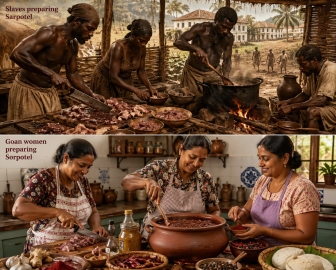
Beyond Goa’s rich heritage, vibrant dance, stunning architecture, sun-kissed beaches, and warm-hearted people lies its timeless culinary delight ” a treasured tradition savoured and passed down through generations. From flavourful pork and beef delicacies that form the heart of Catholic-influenced Goan cuisine to fiery curries, hearty stews, and beloved street-side snacks, Goa’s cuisine beautifully reflects a fusion of Portuguese and Indian influences blended with local spices, coconut vinegar, and aromatic ingredients. Among these iconic dishes, Sorpotel remains a timeless and richly cherished delicacy, celebrated for its bold flavours, festive spirit, and deep cultural roots in Goan tradition.
The origin
Portugal colonised Brazil from 1500 to 1822, beginning with the arrival of the Portuguese explorer Pedro Ãlvares Cabral in 1500. During this colonial period, enslaved Africans formed the backbone of plantation and mining labour, especially on vast sugar estates and in gold mines. Many were also forced into domestic and urban work ” cooking, cleaning, childcare, carrying goods, and serving as escravos de ganho, enslaved people who earned money for their masters through street labour and trade.
Among their many duties was the slaughtering and preparation of pigs for wealthy colonial households. The finest cuts of meat disappeared into noble kitchens and lavish banquets, while what remained behind were the discarded portions ” liver, heart, tongue, intestines, lungs, ears, and bowls of fresh blood.
The slaves took what nobody wanted. History rarely records hunger, but hunger writes its own recipes. Around the smoky fires of plantations and workers’ quarters, enslaved Africans transformed these unwanted scraps into nourishment. They chopped the meat into tiny pieces so that every morsel could feed many mouths. The mixture was boiled, salted, and preserved with vinegar to withstand the unforgiving tropical heat. Pig’s blood thickened the stew, giving it a dark richness and intense flavour. What emerged was not merely food, but resilience simmering in a pot.
Thus was born Sorpotel ” a dish whose name is associated with mixture or confusion, reflecting the medley of ingredients that went into its making. Over time, Portuguese sailors and settlers developed a taste for the preparation and carried it across the Atlantic to Portugal. In the Alentejo region, the dish evolved further into Sarapatel, a mysterious and deeply spiced blend of offal, vinegar, and slow-cooked meat.
But the story did not end there. As the Portuguese Empire expanded across the oceans, ships sailed endlessly between Brazil, Africa, Macau, Mozambique, and Goa, carrying not only spices, people, and trade, but also memories and recipes.
The Goan Sorpotel
When the dish finally reached the shores of Goa through Portuguese maritime trade, it encountered an entirely new world of flavours, ingredients, and culinary traditions. In Goan kitchens, the recipe evolved once again into something far richer and more distinctive. Local women replaced European wine vinegar with the sharp, fragrant tang of coconut toddy vinegar, giving the dish its unmistakable Goan character. Kashmiri chillies entered the pot like red fire, staining the curry with a deep crimson glow while adding both colour and warmth.
Soon, the aroma of peppercorns, cloves, cinnamon, cumin, garlic, ginger, and other Indian spices began to weave themselves into the simmering stew. Each ingredient added a new layer of flavour ” smoky, spicy, tangy, earthy, and intoxicating ” transforming the humble offal dish into a bold culinary masterpiece. Slow-cooked over wood fires, the curry absorbed the soul of Goa itself.
What had once been a dish of plantation survival gradually transformed into ceremonial food ” prepared with care for weddings, Christmas, village feasts and celebrations, and family get-together. Yet the most fascinating mystery of Sorpotel is that it tastes better after days. Not immediately after cooking. But three days later. Sometimes four. The vinegar matures it.
The fat seals it. The spices deepen like old secrets buried in time.
Resting quietly in clay pots or old kitchen vessels, the curry darkens and thickens as the flavors slowly fuse into something far richer and more complex than on the day it was prepared. Traditional Goan homes understood this ritual well. During Christmas or weddings, Sorpotel was often cooked days in advance and left undisturbed to mature before the feast ” ageing like memory, like longing, like the lingering shadows of colonial history itself.