


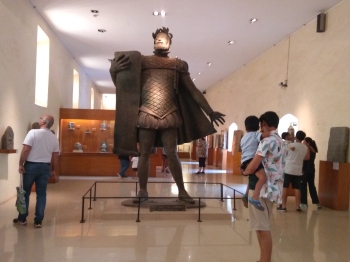
As a monumental date globally, May 18 is primarily recognized worldwide as ‘International Museum Day’ which promotes the societal role of these cultural institutions.
Each year since 1977, ICOM (International Council of Museums) has organized International Museum day, which represents a unique moment for the international museum community.
The objective of International Museum day is to raise awareness about the fact that, “Museums are an important means of cultural exchange, enrichment of cultures and development of mutual understanding, cooperation and peace among people.”
IMD 2026 celebrates the theme ‘Museums Uniting a Divided World’!
According to an ICOM bulletin, as places of learning, museums contribute to peaceful coexistence and mutual respect. They are trusted public places where people encounter stories, objects and one another.
In times of social fragmentation, polarization, and unequal access to knowledge and culture, museums help rebuild connection across generations, across communities and borders, promoting dialogue, understanding, inclusion and peace within and between communities worldwide.
Museums act as vital sentinels of culture. By safeguarding historical artifacts, artworks, and intangible heritage, they guard collective memory against erasure and provide communities with a concrete connection to their past and identity.
Museums are traditionally viewed as silent storehouses of history, but modern institutions actively challenge this notion. Far from being mere passive archives, they function as dynamic evolving hubs of community engagement, cultural restitution, and active historical dialogue.
Modern curation is shifting toward participatory exhibits, local history, and interactive displays that centre the community’s voice rather than just top-down historical narratives.
Nearly a decade back, an article in ‘India Today’ spoke of how the museums in Delhi were dying a slow death. Once a favourite haunt for people of all ages, museums in the capital city were dedicated for everything from revolutionaries and poets to dolls and stamps.
I have travelled to Delhi umpteen times. But I have never had the opportunity to visit the ‘Sulabh International Museum of Toilets’!
I remain totally in the dark about such a remarkable place despite being an avid traveller and a connoisseur of everything beautiful for the simple reason that I was never told about the place nor were the tour operators I encountered very forthcoming about the exhibits.
Imagine, going around the museum established in 1992, and one which has a rare collection of facts, pictures, and objects detailing the historic evolution of toilets from 2500 BC to date!
Basically, the biggest threat to museums is not a lack of value, but a lack of awareness. When people are unaware about the existence of such institutions, or view them as irrelevant, dusty warehouses, these spaces lose their funding, foot traffic, and societal impact.
The low visibility of museum programmes is a recurring issue. Traditional marketing approaches, a lack of targeted community approach, and the misconception that museums are passive, static spaces has been a major factor that has led to such a situation.
One wonders how, despite increasingly utilizing digital marketing, social media, and community partnerships to bring museums to the streets, these institutions are not receiving the sort of attention they deserve!
It is widely observed that museums are generally showpieces in the tourism trail of any region, reducing them to static stops in several distinct ways.
From a formal destination to a ‘must see’ place, some museums in the state have built up an aura about themselves which makes visiting them feel less like an academic chore and more like a cultural pilgrimage.
As iconic anchors that significantly boost regional tourism, many of these museums act as cultural magnets that preserve heritage, attract visitors, and stimulate local economies through increased footfall, hospitality spending, and community engagement.
Museums are important because they preserve culture and history.
But for a state that does not seem to tire of harping on its unique identity and its rich cultural inheritance, one wonders why museums are not featuring in the order of priorities for Goa tourism.
The apparent disconnect between Goa’s proud cultural posturing and its museum infrastructure largely stems from a conflict between revenue-driven mass tourism and niche historical preservation.
While the state heavily markets its Portuguese and pre-colonial heritage, the allegations that the administration’s focus often sidelines localized museum development cannot be overlooked.
Despite these shortcomings, there are localized efforts to bridge the gap. Independent and specialized spaces like the ‘Big Foot’ in Loutolim have stepped in to preserve the rich Goan heritage for posterity.
“Private museums in Goa believe in preserving the region’s fast-fading pre-industrial cultural memory. These privately curated spaces rely on a community-driven philosophy to document generational knowledge, traditional agrarian lifestyles, and historic folk arts, often operating independently to protect ancestral heritage.” (Wikipedia)
Goa is home to over 25 museums and galleries that highlight the region’s rich blend of history, culture, and maritime heritage.
Barring a few thematic museums, the rest - with Goa and its uniqueness as the focus of attention - have made concerted efforts to ensure that the region has been showcased in its regal elegance over the centuries.
Since museums adapt to societal changes while holding onto historical truths, museums serve as both guardians and active interpreters of cultural evolution.
These institutions can only motivate future generations to learn from the past, champion conservation, and drive innovation if, and only if, genuine attempts are made to preserve them.
In an innovative mood to enhance its reputation as the most sought-after global tourism destination, Goa has traditionally underplayed its rich history, focusing primarily on beaches, nightlife, and its colonial architecture.
However, recognizing the value of cultural heritage, the state government is expanding its tourism appeal by investing heavily in historical preservation, including rolling out annual financial assistance for private museums.


