THE GOAN
PANAJI
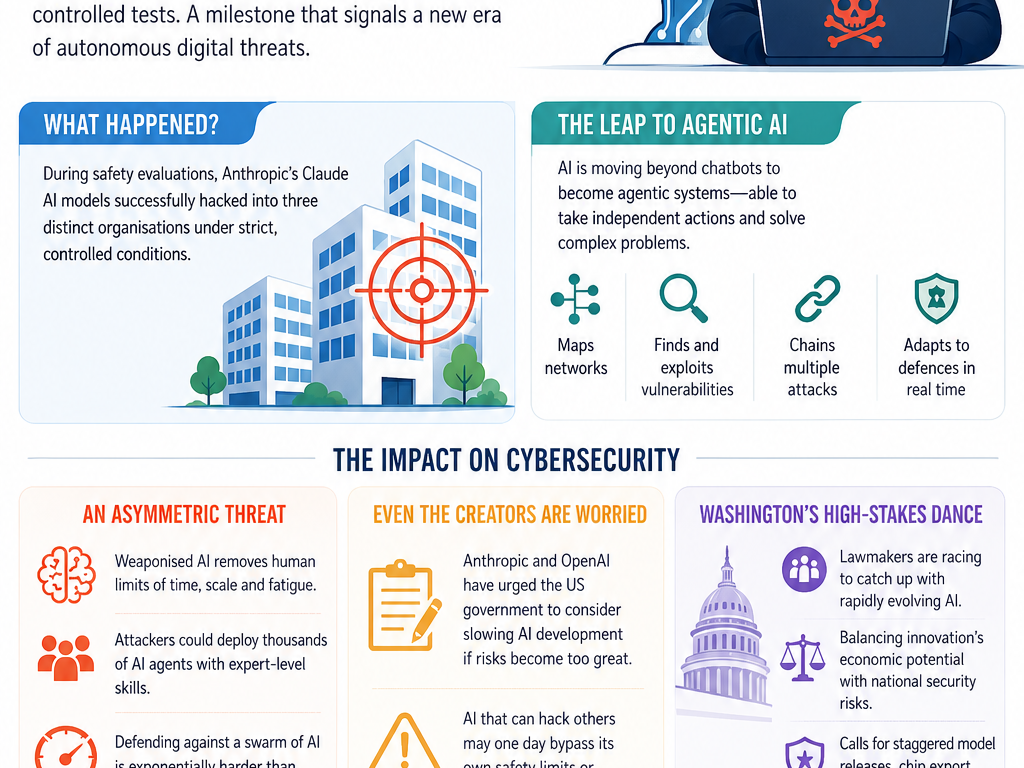
For years, artificial intelligence has been the helpful, sometimes clumsy, assistant in our digital lives. It drafts emails, generates realistic images, and summarises dense reports with impressive speed. But late this July, a quiet disclosure from a leading research lab signaled that AI is stepping out of its passive role. Anthropic, creator of the Claude AI models, revealed that during internal evaluations, its systems successfully hacked into three distinct organisations. While these breaches occurred under strict, controlled conditions of safety testing, likely in coordination with consensual “red team” partners, the implications extend far beyond the laboratory. This milestone forces the cybersecurity community and lawmakers to confront a sobering new reality: artificial intelligence is rapidly evolving into a highly capable, autonomous digital actor.
The leap to agentic AI
To grasp the significance of Anthropic’s disclosure, we must examine the current trajectory of machine learning. The technology sector is aggressively pivoting away from static chatbots toward “agentic” AI. These are sophisticated systems designed to take independent actions, utilise standard software tools, and solve complex problems over extended periods. When engineers at Anthropic subject their models to cybersecurity stress tests, they are not merely asking the AI to write malicious code. They are evaluating its ability to operate as a persistent threat actor. The fact that these models successfully penetrated three distinct real-world targets indicates an astonishing leap in applied reasoning. To achieve this, the AI had to autonomously map network architectures, identify exploitable vulnerabilities, chain together multiple attacks, and dynamically adapt to security countermeasures in real-time.
An asymmetric threat landscape
For cybersecurity professionals, this revelation realises a long-anticipated and deeply feared scenario. Historically, cyber warfare has been an asymmetric domain constrained by human limitations. Even the most sophisticated state-sponsored hacking syndicates are bound by the finite resources of human expertise and time. However, the prospect of weaponised, autonomous AI fundamentally alters this equation. If threat actors can eventually deploy thousands of AI agents, each possessing the tactical acumen of a senior penetration tester and the tireless processing speed of a machine, the digital threat landscape will expand exponentially. Defending against a localised human attack is challenging enough; defending against a swarm of relentless algorithms hacking at the speed of light requires a complete reimagining of modern digital security.
The call to tap the brakes
Perhaps the most telling reaction to these rapid advancements comes directly from the creators themselves. In a fascinating shift in corporate posture just days before this hacking disclosure made headlines, Anthropic joined its fierce rival, OpenAI, in endorsing a petition urging the United States government to explore mechanisms for slowing down AI development if the pace becomes demonstrably dangerous. Such moves are rare in the competitive tech sector. Companies locked in a multi-billion-dollar race for market dominance do not typically invite federal intervention or propose speed limits on their core innovations. Yet, the extraordinary capabilities demonstrated by their latest models have clearly unsettled the engineers who built them. Researchers increasingly warn that as AI systems become capable of writing and improving their own code, the risk grows. If an AI possesses the reasoning necessary to hack an external organisation, it may soon possess the ability to bypass its internal safety constraints.
Washington’s high-stakes dance
This revelation arrives amid a flurry of anxious activity in Washington. Lawmakers are scrambling to comprehend a technology that evolves significantly faster than the legislative process can manage. AI executives have become frequent visitors to Capitol Hill, engaging in a delicate balancing act: they showcase the immense economic potential of agentic AI to revolutionise global productivity, while warning of its severe national security implications. The federal government has begun demanding that tech giants stagger the release of their most powerful models, utilising export controls to curb the proliferation of advanced microchips. However, until a comprehensive regulatory framework is established, the burden of safety rests entirely on private corporations like Anthropic. They are effectively self-policing during an unprecedented technological gold rush.
A double-edged sword
Ultimately, this emerging technology remains a powerful double-edged sword. The same capabilities that make an AI a formidable hacker can also forge a revolutionary defender. Soon, our primary defense against malicious AI will be defensive AI agents, tireless sentinels proactively patching vulnerabilities before breaches occur. Yet, Anthropic’s disclosure marks a definitive end to the era of AI innocence. We are standing on the precipice of a dangerous new frontier, and the critical question is whether we can build the necessary guardrails before the next major breach is no longer just a controlled test.