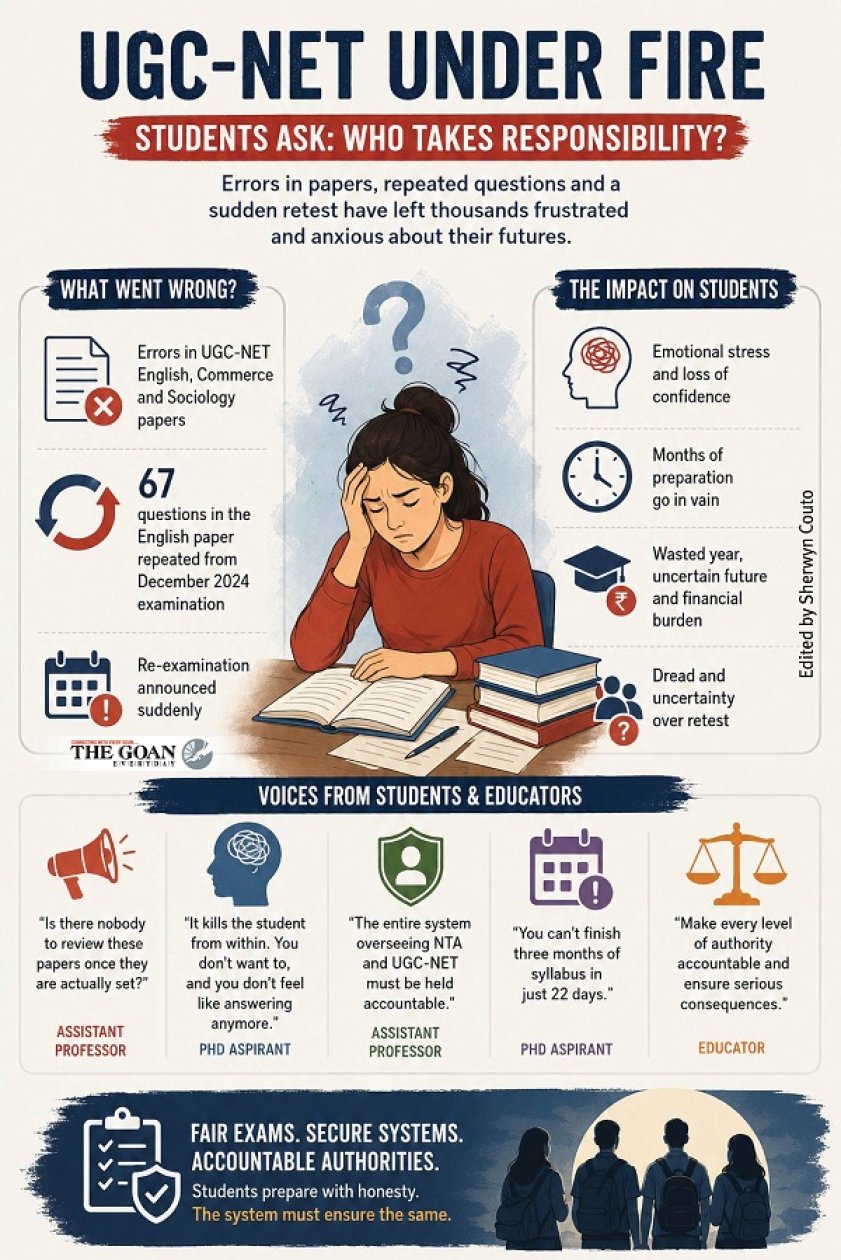
The alarm rings before sunrise. Notes are revised over hurried meals, and family functions are missed. For months, everything leads to a few hours in an examination hall. But fresh scrutiny of the UGC-NET has once again exposed serious flaws in the examination system. Months after the NEET-UG paper leak, the National Testing Agency has once again come under fire. The UGC-NET English, Commerce and Sociology papers were found to contain errors, while 67 questions in the English paper were repeated from the December 2024 examination.
For students appearing for these examinations for jobs or higher studies, such failures can mean a wasted year and a blow to their confidence. Thousands of aspirants are now asking questions that are troubling them: what happens when the examination itself fails them? How do they prepare all over again? What guarantee is there that the next test will be error-free? And finally, how can such failures be stopped once and for all?
Student frustration
Fianka Barreto, an Assistant Professor of English who appeared for the exam, had hoped to clear it this time. “But all went down the drain! All these years, I saw others stressing themselves out; now I see it myself.” Her frustration lies in the fact that an agency that takes months to set question papers and another two months to evaluate them could realise only later that errors had been made. “Is there nobody to review these papers once they are actually set?”
Gordon, who wants to pursue a PhD, speaks of the emotional toll it has taken. “I know this sounds dark, but it kills the student from within. You don't want to, and you don't feel like answering anymore.” For educator Stesha Pereira, the larger issue is that students spend months, and sometimes years, preparing for an exam that can shape their futures. “These exams decide people’s futures. Students shouldn’t have to pay for the incompetence of a corrupt system,” she says, adding that such breakdowns are deeply infuriating.
Accountability questioned
The anger, however, is directed beyond the individuals responsible for setting the papers. Princy Carol Gonsalves, Assistant Professor in English, says the entire system overseeing the NTA and UGC-NET must be held accountable. “They had enough time to check the question papers before the exam. They should have been responsible enough to check everything then, and not realise their mistakes nearly two months after students answered the exam,” she says.
Reacting to the announcement of the re-examination date, Gordon says the authorities appear to have overlooked the practical burden being placed on candidates. “They clearly don’t care how it will affect us. And you can’t start and finish three months of syllabus in just 22 days,” he says, adding that the NTA, the NET committee and the government must all answer for the failure.
Retest dilemma
The sudden announcement of a re-examination has also put Fianka in a difficult spot. “Everyone has their own plans and schedules. Several must have even stopped preparing, thinking they had cleared. But now I have to answer with hardly any preparation,” she says, hoping her year is not wasted.
That uncertainty has left many dreading the retake rather than welcoming it. “Just declare the results. Their incompetence should not result in students suffering. We don’t want a retest, we just want our results,” admits Gordon. He points out that the defence that such issues have happened before can no longer be accepted. “Because if this used to happen before, then what is the point of the NTA’s existence?”
Systemic reforms
While frustration has been directed at those responsible, Stesha says there is no magical one-stop solution. “Yet, one principle rule could fix most of this: make every level of authority accountable,” she says. From end-to-end paper security and tracking every individual who handles the papers to stronger cyber-security for digital systems, she believes the system needs immediate investigations, transparent communication and, most importantly, serious consequences for negligence to prevent such incidents from being repeated.
Rahul Dessai emphasises that the responsibility should not be limited to a handful of individuals, allowing the larger issue to be conveniently closed. “If there was a leak, accountability has to go all the way up the chain,” he says. “Because without consequences, ‘systemic failure’ becomes a convenient way of saying ‘nobody is responsible,’” he reckons.
Questions remain
For now, students are left with more questions than answers. The authorities conducting these examinations have one basic responsibility: to ensure that the process is fair, secure and transparent. Students can spend hours preparing, but they cannot be expected to pay for errors they did not make. If an examination that decides futures cannot be trusted, then the larger question is not just what went wrong this time, but what and who exactly can students trust?