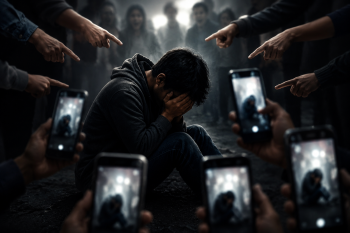
He could be a youth from any of our neighbourhoods, helping with a household chore and making what one could call a thoughtless mistake. While he dumped garbage on Wednesday, someone recorded him and questioned his actions. The clip was uploaded to social media.
The youth was called to the police station to answer for his act. Then, in the early hours of Friday, he ended his life, apparently after being under severe emotional stress following the circulation of the video clip on social media and the registration of a police case against him.
An ordinary human failing, a public spotlight, a social feed lit up with judgement, and a young life lost under the weight of humiliation. This is not simply about litter or law; it is about how we, as netizens, can turn well-intentioned correction into a disastrous outcome.
What happens to a person when shame is made public? Shame is an intense emotion that focuses on a specific act and may result in reparative action in order to set things right. It can do good, but it can also result in harm.
Research by Tangney, Stuewig and Mashek points out that shame promotes withdrawal, secrecy and avoidance rather than constructive repair. When a person’s mistake becomes a public spectacle, the experience of shame is magnified by the exposure, and the world is perceived as hostile.
Social media can compound the psychological load of such an experience. The immediacy and permanence of a viral clip, coupled with a chorus of comments, can be horrifying for the person being shamed. Cyberbullying literature informs us that public shaming elevates perceived social isolation and increases the risk of depressive symptoms and self-harm. For adolescents and young adults, whose self-concept is still forming, being publicly shamed can fracture emerging identity in ways that have long-term consequences.
Several social and psychological factors can push people towards public shaming. Expressing anger at perceived wrongdoing can signal moral superiority to others. It may reward harsh judgement when gentler correction could be more effective. Being anonymous behind a screen enhances a state of deindividuation, and the lack of face-to-face contact makes harsh statements easier; consequences seem smaller because the target is just a screen name.
The fundamental attribution error suggests that observers often attribute visible wrongdoing to personal flaws but attribute their own errors to situational factors, which further adds to the condemnation of mistakes made by others.
If the goal is to improve civic behaviour, as in the recent incident, public shaming has proved to be a blunt and destructive tool. Effective correction should be educative and restorative. Prioritising gentle private correction first allows a person to learn without losing face. Law enforcement agencies, authorities and even well-meaning citizens must respond proportionately and sensitively, especially when minors and young people are involved.
The psychological damage caused by public shaming can set in motion a cascade of negative outcomes. The shamed victim may experience a decline in mental health, social isolation, stigma, and even aggression and retaliation, which may be disproportionate to the original act. Some individuals demonstrate resilience after public humiliation; others do not. Protective factors such as family support and the ability to reframe the incident by seeing it as a mistake can help. However, resilience should not be a burden we place on victims. Telling someone to “be resilient” after they have been crushed by public contempt is difficult.
Instead, in this age of social media scrutiny, we must build environments that prevent such humiliation in the first place. A community helpline or a trusted NGO can intervene to offer support and de-escalate situations before comments multiply. Instead of anonymous reporting, online platforms and local influencers should be encouraged to report offences to the appropriate authorities. This story is a painful reminder that when we choose spectacle over compassion, we risk lives. If we care about cleaner streets, let us also care about human lives.
(The writer is an Associate Professor and Head of Department of Psychology at St Xavier’s College, Mapusa)