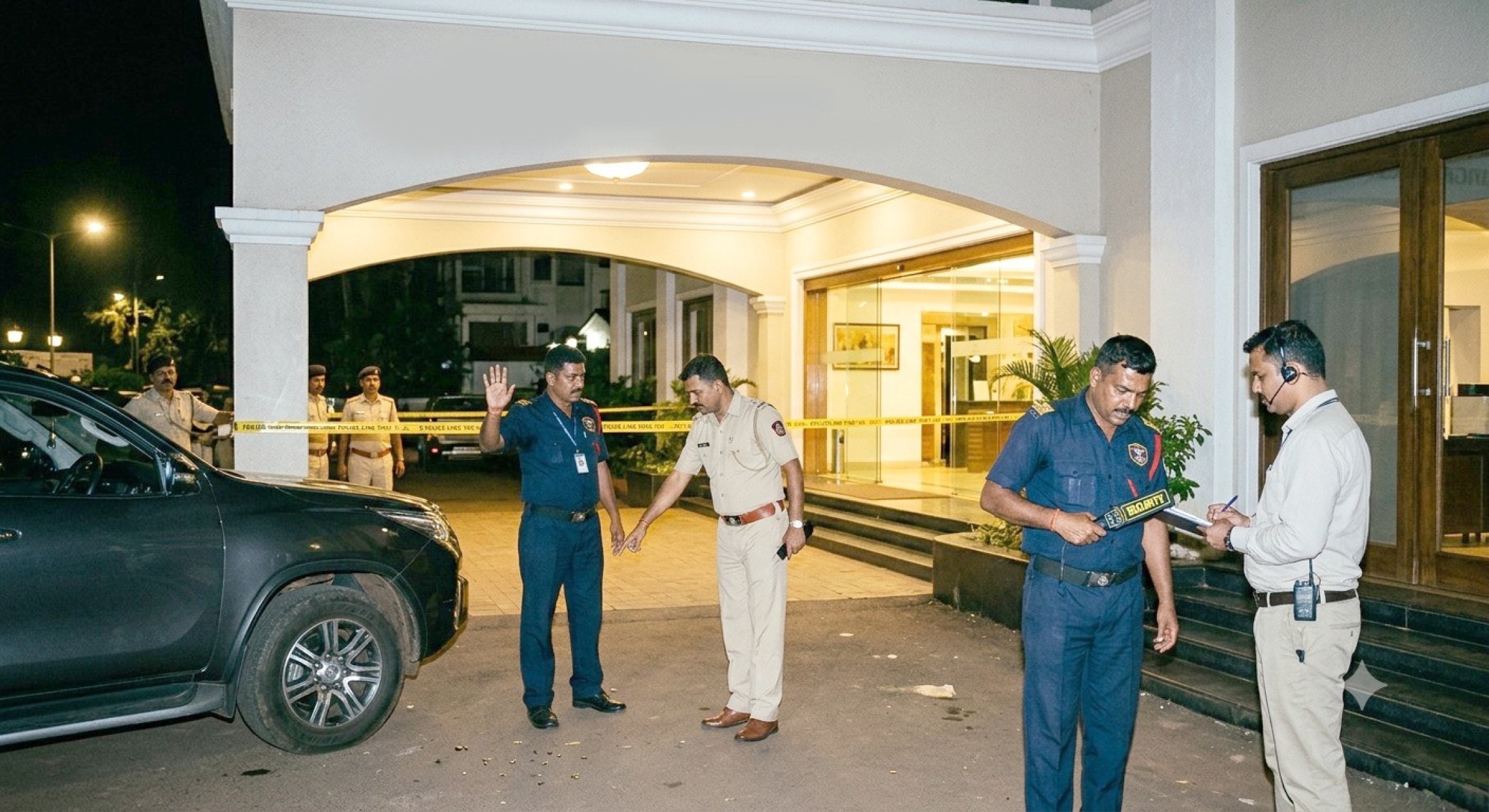
A shooting outside a hotel is enough to unsettle any city. Still, when the target is a prominent business figure, and the attackers manage to get within firing range, it raises a larger question: how secure is Goa? The August 28 firing at the Majestic Hotel in Porvorim, where two unidentified men allegedly opened fire at Srinivas Nayak, director of the Majestic Pride Group, has brought this question into focus. Although Nayak escaped unharmed, the police have detained two people as part of the investigation. Beyond the immediate police probe, the incident has prompted security agencies to look at what happens when such an attack takes place.
Security protocols
Srinivas Shetty of Security Services Goa explained that security agencies have several Standard Operating Procedures (SOPs) in place to deal with incidents of this nature. He said that while security concerns earlier largely involved unwanted paparazzi or individuals invading a client’s personal space, the rise in violent crime has changed the nature of threats. “There are certain Standard Operating Procedures that are put in place when situations like these occur,” he said. “However, shooting is unpredictable. No one knows whether someone will open fire. The best way to prevent something like this would be to secure the premises,” he said. Shetty also clarified that while armed security personnel can be hired, they are legally restricted from using their weapons. “You can hire armed security personnel; however, they cannot shoot or use their arms, and it is against the law, unless someone fires at them first or there is a threat to their life,” he explained.
Entry point lapses
Mario Dickson of J Hawk Security expressed concern over how the alleged shooters managed to enter the premises and get within firing range of the target. “There are metal detectors which generally sound an alarm. It is quite bizarre to see that the arms were not detected when they entered,” he remarked. CCTV footage of the incident has since circulated widely online. Both Shetty and Dickson emphasised that stricter security at entry and exit points could have helped prevent the incident. “The names have to be entered, while also making note of the reason for meeting. The luggage should be checked; the ID should also be checked. Even if it is someone familiar to the person,” Dickson said, adding that the growing incidence of violent crime in Goa was a matter of concern.
Manpower concerns
Shetty also observed that hotels and other establishments often compromise on security by deploying fewer guards than required, largely as a cost-cutting measure. “Most of the time, for cost-cutting, hotels and other places deploy only three to four guards where they should have eight to ten guards,” he said. He added that establishments need to ensure adequate manpower to monitor and screen people entering and leaving the premises. According to Shetty, security is sometimes deployed merely as a formality, without adequate attention to established protocols and SOPs. “Security has some protocols and SOPs. If it is a casino, the authority’s concern should be about drunken people, fights and all that. So then the agency’s responsibility will be to train the guards,” he said.
Client concerns
Manav from Group One Security mentions that they mostly see to providing security at hospitality sector and for events. “When clients come to us, they usually have 2 primary demands: one is to prevent theft and robberies and the second is to provide safety to the individuals as well as the guests,” he says, emphasising the protocols that have to be generally followed during incidents like these. “First and obvious is to either inform the company about the incident or the police station,” he states. However, he maintains that the demand from the clients has not undergone a dramatic transformation. “The business people who already felt that they were facing threats have taken this a bit seriously; for the rest, it is not much of a difference, he reckons.
Preventive measures
With the recent incident putting the spotlight on the safety of high-profile individuals, security agencies stress that prevention must begin at the entry point itself. Thorough checks of every person entering the premises, verification of identities, monitoring of movement within the property and adequate deployment of trained personnel can help reduce security lapses. They also advise hotels, businesses and event venues to engage security agencies that are police-verified and comply with the Private Security Agencies Regulation Act (PSARA). As threats evolve from unwanted intrusion to more serious and potentially armed confrontations, they point out that security can no longer be treated as a formality, but has to be approached as a structured and proactive responsibility to be followed by all.