The year was 2014, and I had just shifted with my family from Chicalim to Navelim. Accustomed to the port town since my childhood, adjusting to Saxtti was a new challenge at my age; from renting an apartment close to our workplace, to getting children admitted into a new school.
Those years were tough for me and my family for many reasons; it was a new turf with a new neighbourhood. Going by my name and dialect, Saxtti regarded me as an ‘outsider’. I was missing my old and ailing parents back in Chicalim. My Father often required hospitalisation due to his COPD and mother was paralysed and bedridden. Due to academic preoccupations, I’d visit them on weekends and my wife would make it more often. Of course, we had a full-time in-house caretaker for our parents.
Every morning I’d drop my daughter to her tuition classes, from where later she’d walk to her school. On my way back at about 7 am, after crossing the Margao Municipality I’d enter Bharat Café opposite Hindu Pharmacy, to pick my newspaper. If the aroma got irresistible I’d sit savouring the delectable patall bhaji, simultaneously running through the news headlines.
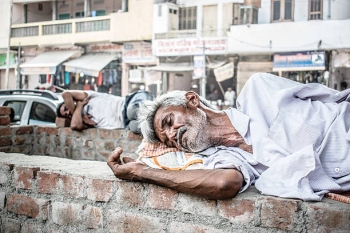
One such uneventful morning while sipping my tea, my attention was drawn to a middle-aged man who was engrossed sweeping the pavement along the Bharat Café. He clearly appeared weak and not in the best of his health. As he bent, his loose and somewhat soiled shirt opened up and I could see the fluorescent rosary beads and the cross around his neck. As I stared at him, he got conscious but mustered courage to smile at me and nodded his head to wish.
I did not realise when I gestured inviting him to join me at my table, and he hesitatingly came in standing next to my table. I offered to pay for his breakfast but he politely declined and said he only required tea. After gulping down tea, he thanked me and went away. The cashier, seemingly astonished at this, told me that the man was a destitute and had sought refuge under the stairways beside the hotel for quite some time. Being old and infirm he could not do manual labour and rested in that corner for most of the time, but every morning would regularly clean the pavement along Bharat Café in return for some amount. He ended his day and day’s earnings drinking cheap liquor.
Despite this tainted picture, I felt compelled to help this man whose name was Dominic. I wasn’t sure what exactly about Dominic appealed to my soul. As days passed my morning halts at Bharat Café got more regular, just as my acquaintance with him. I was now regularly sharing breakfast with him and seeking to bail him out of his disdainful life. My bizarre concern for this man was now known to my family and a few colleagues. I offered to pay his monthly meal expenses by speaking to a restaurant, but he confessed he had alcohol dependence and needed that, besides food. Thinking dispassionately, I regularly gave him money in moderation for his life and an advice to be away from the vice.
Few weeks later I saw Dominic groggy and lying down helplessly on the bench around the Municipal garden. My wife and I walked towards him trying to talk to him. In that state too he tried to wish us both and a faint painful smile appeared on his face. The man had visibly deteriorated as evident from his cheek hollows. Sunken eyes, swollen feet and an emaciated body indicated starvation. My wife immediately got a food parcel and as he raised his wrinkled hands in gratitude, and I took my decision to shift him to a sanitarium or a home for the aged, even if at cost.
Next few days I scouted for places where Dominic could receive medical attention and care until his complete recovery but nothing was crystallising into a comfort zone for Dominic. Being labelled as an alcoholic destitute, he did not meet the requirements for admission into any government facility. While Dominic continued languishing on the garden bench braving the winter, my wife covered him with blankets that would soon go missing. I ensured that he ate at least one proper meal a day.
Around this time, my father fell seriously ill and despite the best health interventions succumbed to his chronic ailment. Busy in the posthumous rituals for the next 12 days, my focus shifted from Dominic. Upon our return to Margao, we found that the bench was occupied by some other beggar and Dominic was nowhere to be seen. We enquired with the shopkeepers, restaurants; searched bars and the whole town to locate Dominic. My wife made several trips to the Police Station to enquire if he was shifted and kept elsewhere. Thinking of the worst-case scenario, she checked the morgue registers too. Finally, astonished by her sense of concern, an old fisherwoman behind the Municipality told her what was unknown to all of us until then.
Dominic had died on that bench, uncared for and alone. When the police arrived to pick up his body, they found in his possession a photograph and an address of his family in Maharashtra. The sorrowful wife and children on being contacted arrived in Goa and revealed that he had left home years ago in a feat of rage. From a well-to-do family, his anger and ego held him back. His false sense of pride made him a destitute in a faraway land. The grief-stricken wife decided to give him a well-deserved funeral and Dominic now rests in peace in the cemetery opposite the Hospicio.
I feel guilty at my failed attempt to restore his dignity in life. Transcending the boundaries of faith, affluence, education and status, perhaps Dominic came into my life to give me experiential lessons in compassion.
(Author is a senior academic and a reputed Biologist)