Last week, I had some work at a government office. Somehow, I reached there without knowing the details of a file which I needed to access. It seemed like an obvious mistake on my part. I was on the point of giving up. Just then, a lady employee took some extra interest in helping out.
She asked a few questions, and took extra trouble to find a solution. In five or ten minutes, the file in question was located. The required correction was made, and one would not need to return to the same office once more.
So, what is the point of the above story? Government offices can be cold and heartless. Their staff always feels overworked. More importantly, they don't have any incentive to put in their best.
If they serve, or even if they don't, their salary comes through at the end of the month. This is not to be unduly harsh on government servants; they often feel their efforts are not being appreciated. In addition, if they show extra initiative, they could get penalised for the same.
In such a setting, you can get optimum service only under certain conditions. Either you know someone there (the Goa Medical College is a good hospital, provided you have 'influence', as the common perception goes). Or, you come across the rare extra-conscientious government employee. The third option is that someone there takes a personal interest in your case....
I could have been imagining things, but the fact that the lady in question shared the same religious faith as mine (or what it is perceived to be) seemed to have made a difference. In today's Goa, having some shared connection can give the edge.
In our times as journalists, it was always obvious that someone who was "like you" was more likely to open up. Or, to offer access to information. It could be either a politician or a bureaucrat. If you had common friends, came from the same area, or (a sad fact) shared a caste or religious connect, the chances of "getting the job done" was higher. But this was not an unmixed blessing.
Those journalists who were "better connected" were also more likely to be made use of, by their "friends" and "connected folk". News and stories could be more easily planted on them. Or, they could be manipulated.
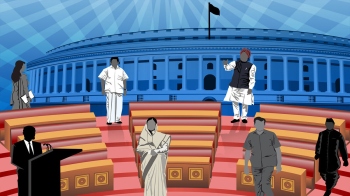
In this context, the issue of representation in the government is most important. Do the staffing pattern of our government offices -- and the election results that emerge regularly -- actually reflect the reality of our State and our country? In Uttar Pradesh, the BJP has won a big win but doesn't have a single Muslim MLA on its party rolls.
India has seen a growth in communal and sectarian thinking since at least since the mid-1980s. In Goa, the pattern was different and we have had low-intensity communalism from the 1960s, and before that in another form. This has polarised society.
Soon after the assassination of Indira Gandhi, politicians realise the power of dividing and ruling. It started off with its Sikh-targetting electoral campaigns. In the last decade, this has grown to new highs. Ideological and propaganda campaigns sustained over long years have justified communal discrimination.
A cursory look would show that, when it comes to employment, not everyone gets a fair share of the jobs. Not much needs to be said; just visit any government office in Goa. But then, when sectarian thinking has spread so deep, both in the ruling and sections of the Opposition too, what can one expect?
Everyone needs to feel a sense of participation in managing the affairs of the State. Representation to different sections is important. This is true not just when it comes to religion, but also to castes and other such groupings.
To acknowledge this, the governments at the Centre and the State have gone about implementing quotas for different segments. This is what caste-based reservations are all about. If so, how is it justified to leave out vast sections of others then, just because these are not beneficiaries of caste-based quotas?
To argue that a "majority wins" is just an oversimplification of the issue. A well organised group cannot overwhelm everyone else in society just on the grounds that it weaves together a brute majority. Representation is important because it has other implications too.
A State which is not representative, excludes. Governments, law-enforcers and bureaucrats can turn partisan. This reduces sections of its population to a near-colonial status. Take a look at the State-crafted textbooks of Goa, and you'll get an idea of how it depicts various sections of the population.
Languages (especially scripts and dialects) of some get sidelined and delegitimised for use. An extreme case is that of Sri Lanka, where decades of discrimination against the Tamils led to a bitter secessionist movement.
By some coincidence, I was just reading a review by our senior (and now Mumbai-based) journalist Mario Cabral e Sa, titled 'The Great Anthropological Joke'. His review was of the Anthropological Survey of India's (AnSI) volume 'People of India: Goa', published in the 1990s. It creates a whole lot of myths and inaccuracies, while trying to write about a people it cannot understand.
If this is clear at the level of understanding, you can imagine how serious it gets while trying to administer people you can't understand.
One generation or so ago, it would be considered impolite to discuss religious or caste differences. We all saw ourselves as working to build 'unity in diversity' based society. One which took all sections along with it. But today, as bigotry grows all around, perhaps such questions can be ignored at everyone's peril.