Reading will always remain that pastime eulogized as one that is precious and enjoyable. But it would be foolish to expect all that encomia to compensate for the disinclination shown by a majority towards nurturing reading as a hobby that is enriching and productive.
The other day a teacher friend of mine was telling me how difficult it was to get students these days to write a few decent lines, grammatically correct and to the point. Ask some of the MBAs working in various capacities in business houses across the country about the letter writing skills of their clerical staff and you would have succeeded in touching a raw nerve!
Would it be right to blame the technological revolution witnessed by the modern era for the trivia!
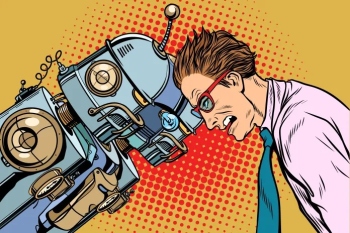
The smartphone already stands accused of creating a generation of robots whose excessive reliance on everything that it has to offer has created a trend which entails going beyond what is necessary or healthy.
Besides the plethora of ‘apps’ adorning the console which make life all the more easy for those operating the applications, the smartphone seems to have become an appendage - an extension of the human body.
This however reflects the profound and pervasive integration of these devices into our daily lives where they are now seen as essential tools for communication, information access, and entertainment, impacting various aspects of human interaction and society.
But a life sans a smartphone is hard to comprehend considering its utility in an age where the ‘tip-of-finger’ accessibility to various amenities makes it an indispensable feature of modern day living.
It is however the virtual enslavement of mankind to smartphones that has become the topic of animated discussions on various platforms which should have served to alert one and all to the horrors of mobile addiction. Yet, none of these debates have succeeded in putting across the empirical truth about the horrors of the fraught relationship between human beings and cell-phones.
But can we rebut the fact that modern inventions have made us slaves of our ever-evolving technological advances? A simple task as letter writing is now best left, relegated to the realm of artificial intelligence (AI).
With the ability to learn, reason, make decisions, and process natural language, AI refers to the development of computer systems capable of performing tasks that typically require human intelligence.
It is asserted that AI’s integration into daily life is both profound and diverse. Healthcare, finance, transportation, entertainment; not a single field is left untouched by the new technology.
However when one says that ‘Artificial Intelligence stands as a testament to humanity’s innovation and technological prowess’, it leaves the door open for quite a few ambiguities that defy logic.
Exploring the growing concern of ChatGPT misuse by students in education throws up the bland truth that as technology continues to evolve, there will be methods devised to exploit the advancements for personal gains.
The manner in which students have often turned to AI-powered tools to complete assignments, essays, or projects, instead of effecting them through one’s own efforts and abilities is alarming to say the least.
The views of a professor friend which had a bearing on this matter served to shock me out of my wits. Her comments about ChatGPT producing some of the best writings, besides the richness of the language used, came as a big surprise to me.
However, the misuse of AI-generated tools to ease their study workload only serves to encourage laziness and a lack of effort in developing one’s own ideas and thoughtful process amongst students.
“As students use AI to manipulate language for convenience, they miss out on the crucial cognitive process involved in constructing knowledge and learning.” Vaishali Jagtap (Asst Prof).
Her contention that ChatGPT and other AI tools have the potential to revolutionize education, but their misuse by students presents significant challenges, thus becomes a clear indicator of the frailties that assail our educational system in the face of emerging technologies in the current scenario.
Has technology
killed creativity! (subhead)
It is however argued that ‘technology does not inherently kill creativity; rather it provides new tools and platforms that can either enhance or hinder creative expression, depending on how it is used’.
Nevertheless, the last part of the sentence, ‘depending on how it is used’, is highly disconcerting considering that the phrase throws up a whole gamut of challenges.
It is the responsible use of technology that needs to be advocated. But that never happens! As we stand at the crossroads of human evolution and technological advancement, it is the damning effects more than the constructive ones which has characterized that mad scramble for supremacy which has pitted nations against one another.
Nevertheless, it does appear that we are tilting more towards a trend where the use of technology, programs, robotics, or processes to achieve outcomes with minimal human input could well spell that end of an epoch where mankind will be seen in a more subjugated role.
If reducing human error is the prime consideration with these technological advances, how do we address malfunctions or failures of technological innovations!
Although the world was introduced to the idea of artificial intelligence way back in 1956, it is claimed that the recent surge in AI’s prominence can be attributed to a combination of technological advancements, data availability, and its increasing adoption across various sectors.
But lest we forget!
“AI is called ‘artificial’ because it refers to intelligence created or simulated by humans designed to perform tasks that typically require human intelligence.”
Hence, the fact that AI is only as unbiased as the data and people designing the programs should serve to caution us about the new-age fixation with artificial intelligence.