For nearly a decade, Indian opposition politics revolved around a paradox. Parties that were expected to collectively challenge the BJP ended up weakening one another more than the ruling establishment itself. Regional leaders who rose as powerful anti-BJP figures gradually transformed into competing centres of ambition. The result was a fractured and distrustful alliance structure that repeatedly failed to convert anti-incumbency into a coherent national challenge.
Ironically, the political weakening of some of these regional heavyweights may now open the possibility of rebuilding opposition unity on more stable foundations. The decline of leaders like Mamata Banerjee and Arvind Kejriwal after successive political setbacks may ultimately strengthen the INDIA bloc by reducing internal contradictions that have paralysed it since its inception.
The burden of regional ambitions: The INDIA bloc struggled not because of ideological incompatibility alone but because of unresolved leadership battles within the opposition itself. Several regional parties expected the Congress to support them in their respective states while simultaneously attempting to erase Congress politically in those very regions.
Personal ambitions further complicated matters: Multiple opposition leaders projected themselves as potential prime ministerial faces without possessing broader acceptability across India. Seat-sharing disputes, public disagreements, and indirect sabotage weakened the alliance far more than BJP attacks. Instead of presenting a united political alternative, opposition parties often appeared engaged in parallel battles against both the BJP and each other.
The political consequences gradually became visible. In many states, regional parties successfully reduced the Congress’s strength but failed to emerge as viable national alternatives. This fragmentation ultimately benefited the BJP, which continued expanding while opposition votes remained divided among competing regional formations.
BJP’s long-term political consolidation: The weakening of regional parties did not happen accidentally. Over the past decade, the BJP pursued a carefully structured strategy aimed at expanding beyond its traditional political geography. Through organisational penetration, welfare politics, narrative control, and leadership centralisation, the party steadily transformed state elections into nationalised contests centred around PM Modi.
One major vulnerability of regional parties was their excessive dependence on individual personalities. Many evolved into leader-centric organisations with weak second-rung leadership and limited institutional depth. The BJP exploited this weakness by engineering defections, attracting disgruntled leaders, and expanding its cadre network within opposition strongholds.
Equally significant was the BJP’s success in appropriating welfare politics. Regional parties once dominated populist schemes tailored to local social groups. However, centrally branded welfare programmes linked directly to Modi diluted the distinctiveness of regional models. The BJP combined welfare delivery with nationalism and strong leadership projection, creating an emotional and political appeal that many regional parties failed to counter effectively.
Investigative scrutiny also contributed to the erosion of regional formations. Whether politically motivated or institutionally driven, continuous enquiries and corruption allegations damaged the credibility of several opposition leaders. Public perception increasingly shifted against parties viewed as family-controlled, personality-driven, or corruption-prone.
Congress finds an unexpected opening: Amid this churn, the Congress may be discovering a political opportunity that seemed unimaginable only a few years ago. Its possible revival before 2029 may depend less on immediate electoral arithmetic and more on the structural weakening of regional competitors that had consumed its political space for decades.
As regional parties lose dominance; Congress once again appears to be the only opposition party with a genuine national footprint. Its governments in states like Karnataka, Telangana, and Himachal Pradesh provide administrative visibility and organisational infrastructure. The party has managed to win Kerala and timely decision to extend the support to Vijay in Tamil Nadu may pay rich dividends in 2029 which will help it to gradually reinforce the perception that it remains the BJP’s principal national challenger.
More importantly, Congress benefits from a deeper political reality embedded within Indian democracy. Long phases of one-party dominance eventually create demands for institutional balance and political counterweights. The BJP’s extraordinary electoral success has simultaneously generated concerns regarding centralisation of power, federal tensions, and a shrinking opposition space. Congress hopes to convert these anxieties into political consolidation over time.
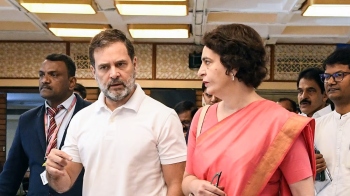
Within this evolving landscape, Rahul Gandhi has emerged as the opposition’s most consistent and visible critic of the Modi government. Though still polarising, Rahul Gandhi remains one of the few opposition leaders maintaining sustained national political engagement on issues ranging from unemployment and social justice to institutional autonomy and economic inequality. As regional satraps weaken, Congress may increasingly attempt to reposition Rahul as the central face of opposition politics.
The Road to 2029: Despite these opportunities, the Congress still confronts serious structural limitations. Its organisational collapse across large parts of north India remains severe. Cadre morale fluctuates, leadership clarity remains uncertain, and electoral machinery continues to lag behind the BJP’s highly disciplined apparatus. Moreover, regional parties may weaken, but they are unlikely to disappear completely. Congress would still require tactical alliances in several key states to seriously challenge the BJP.
For the BJP too, the political terrain before 2029 may become more complicated than previous elections. After nearly two decades of dominance at the centre, anti-incumbency pressures could gradually intensify. Concerns over unemployment, economic inequality, social polarisation, and centre-state relations may increasingly shape political discourse.
The BJP’s greatest challenge may not emerge from a single opposition leader but from the gradual consolidation of a broader anti-incumbency sentiment across different sections of society. If Congress succeeds in reclaiming political space abandoned over the past three decades while opposition fragmentation reduces, the anti-BJP camp could become structurally stronger, even if it currently appears electorally weak.
Indian politics has historically demonstrated that major transitions often begin quietly before becoming electorally visible. The weakening of regional satraps may, therefore, represent more than the decline of individual leaders. It could signal the beginning of a larger political realignment in which the Congress attempts to reclaim the central space of national opposition politics while the BJP prepares to defend an era of prolonged dominance against a slowly reorganising challenger.
-- FPJ