As Goa gradually approaches the 2027 Legislative Assembly elections, an increasingly important political question has begun to emerge. The issue is not merely whether the incumbent government shall be returned to office or whether opposition forces shall gain ground. Rather, the more fundamental question concerns the quality of leadership that will be offered to the electorate and whether emerging political figures possess sufficient public confidence to challenge well-established political incumbents.
The challenge facing Goa's electorate is therefore not simply one of political preference. It is a question of representation, credibility and administrative trust.
Karapur and politics
of public sentiment
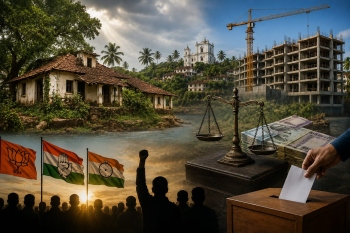
Few issues have illustrated this growing electoral dilemma more vividly than the controversy surrounding Karapur. Public concern has arisen from allegations that a traditional Goan settlement faces substantial transformation in order to facilitate a large-scale commercial housing project.
Whether the project ultimately proceeds in its present form or undergoes modification through legal and administrative processes remains to be seen. However, the political significance of the controversy extends beyond planning regulations and development permissions.
Karapur has become symbolic of a wider public anxiety regarding land use, environmental protection, village identity and the future character of Goa's communities. In electoral terms, such controversies often become indicators through which citizens evaluate the priorities of political leadership.
The issue therefore serves as a reminder that development cannot be measured exclusively through economic outputs. Public acceptance frequently depends upon whether communities perceive themselves as participants in development rather than its casualties.
Political accountability
Elections rarely operate in isolation from past administrative decisions. Voters often evaluate political leaders through a cumulative assessment of policy choices made over an entire legislative term.
In this context, several policy controversies continue to occupy public discourse. Among them remains the continuing debate surrounding statutory provisions that have undergone judicial scrutiny and subsequent reinterpretation. Political observers have frequently noted the lingering political consequences arising from the reading down of Section 17(2), a development that altered the legal and administrative landscape in significant ways.
Simultaneously, increasing public discussion has emerged regarding the operation and implementation of Article 39A-related mechanisms and the extent to which public institutions have evolved into complex administrative structures with substantial financial implications.
Irrespective of differing political viewpoints, these debates contribute to a broader electoral narrative. Voters often ask whether government action has remained faithful to constitutional objectives or whether administrative systems have become detached from the needs of ordinary citizens.
Advantage of established
political figures
One of the defining characteristics of Goan electoral politics is the remarkable resilience of established constituency leaders.
Many sitting legislators possess extensive organisational networks developed over decades. They maintain direct engagement with local communities, social organisations, religious institutions, business groups and village-level stakeholders. These networks frequently survive political controversies that might otherwise damage electoral prospects.
Consequently, electoral success is often determined by more than policy performance alone. Personal accessibility, constituency service and long-standing relationships continue to play decisive roles. This reality presents a formidable challenge for new entrants into electoral politics. Regardless of professional qualifications, educational achievements or policy expertise, emerging candidates frequently struggle to replicate the trust accumulated by established political figures over many years.
The manifesto problem
The modern political landscape increasingly emphasises manifestos, policy documents and campaign promises. While such instruments remain important, their practical electoral value should not be overstated.
Many first-time candidates rely heavily upon manifesto-based campaigns. They present ambitious proposals concerning housing, infrastructure, environmental protection, employment and governance reform. Yet voters often evaluate a candidate through a different lens.
The electorate frequently asks a simple question: who will effectively represent the constituency when administrative difficulties arise?
Manifestos may describe future intentions, but elections are often decided by perceptions of leadership capacity. The ability to negotiate with government departments, secure public works, address local grievances and respond during emergencies frequently carries greater electoral weight than detailed policy proposals.
As a result, new candidates encounter a difficult paradox. They may possess stronger policy platforms than their established rivals, yet still fail to convince voters that they can exercise effective leadership.
Goa nevertheless stands at the beginning of a significant political transition. A younger generation of voters is entering the electorate. Their concerns increasingly include housing affordability, environmental sustainability, employment opportunities, urban congestion and quality of public services.
These voters may not share the same political loyalties that influenced previous electoral cycles.
However, generational change does not automatically translate into electoral transformation. Younger voters often seek alternatives, but alternatives must first demonstrate organisational capacity, credibility and sustained public engagement.
The transition from public activism to electoral success remains one of the most difficult journeys in democratic politics.
Choosing leadership beyond personality
As the 2027 election approaches, Goa may benefit from moving beyond personality-driven political discourse. The electorate should examine not only individual candidates but also their demonstrated record of public service, administrative competence and commitment to constitutional governance.
Similarly, opposition figures seeking public support must recognise that criticism alone rarely secures electoral victory. A convincing alternative requires organisation, leadership and sustained engagement with the communities they aspire to represent.
The contest therefore extends beyond government versus opposition. It is fundamentally a contest between competing visions of leadership.
The road to 2027 is already being shaped by decisions made long before formal campaigning begins. Controversies such as Karapur, debates surrounding administrative policy, and concerns regarding governance have collectively contributed to a growing atmosphere of electoral reflection.
Yet the outcome may ultimately depend upon a more enduring reality of Goan politics. Established political leaders continue to enjoy powerful support structures, while emerging challengers must prove that they represent more than a collection of promises contained within an election manifesto.
In the final analysis, Goa's voters may not simply be choosing between parties. They may be deciding whether experience, familiarity and organisational strength remain more persuasive than reform, renewal and aspiration