The other day, a friend was sharing how poorly informed we in Goa tend to be about our own State. We forget (or be ignorant about) our history. We are surprised to learn about local realities. Overall, we continue to be poorly informed. So what, you might ask?
Well, it does make the earth of a difference. Those who cannot remember the past are condemned to repeat it, as said the Spanish-American philosopher, essayist, poet and novelist George Santayana.
But that's not all. We inherit poor governance because citizens are mostly not holding rulers accountable. We have a warped sense of our past, and this makes it easy for any vested interest to manipulate any crucial debate.
This week saw Librarian's Day being celebrated in India. August 12 has been earmarked as the National Librarians' Day in India. On this day, Dr SR Ranganathan, regarded as the Father of Library Science in India, celebrated his birthday. It is as good as any to remember the importance of information in our lives. In this connection, two sources of information come to mind. One current, and the other mainly a memory. Let's visit them.
Not many may be aware that large amounts of official information is available via the Goa Assembly website. It is at goavidhansabha.gov.in But a direct link to the questions page can be reached by just Googling for goa + assembly + question.
On this site, one can access literally tonnes of information about a whole lot of government activity, expenses, and whatever public issues have been raised by members of the legislative assembly.
You can get constituency-based information here. For instance the number of voters added or deleted from the Siolim constituency rolls. Or information about language. This would be of interest, especially in a Goa where issues about script and Konkani are once again in the news.
Likewise, there's official information on comunidade lands, land scams, bus transport, village panchayats, stray cattle, chopper services to Bat Island, activities at the Ravindra Bhavan-Margao, and a whole lot of other issues where the government interacts with the citizen.
Government information is not the last word on any thing, of course. It could contain errors too. For instance, this columnist noticed a table where one row slipped out of sync, and all the information relating to higher education was misaligned and thus incorrect.
But government information does give an insight into so many issues touching our lives. It also reminds us about what matters are important, and which sectors have had crores spent over them -- sometimes with only poor results to show.
The second example that comes to mind was a centre started by the late Matanhy Saldanha and team, and run by Reggie Gomes. The latter has been an active (if a silent behind-the-scenes) figure in Goa's development debate from the 1980s. This team ran an organisation called GRID, the Goa Research Institute for Development. It was based out of Sant Inez, at the end of 18th June Road, in a building called Despamont.
What made GRID so special was that it tried to collate, manage and make accessible information in times when the public and accessible Internet (as we know it today) was yet to be born.
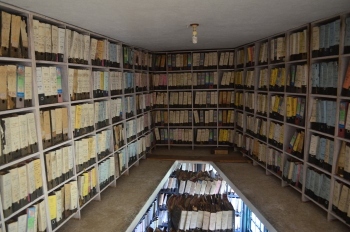
Reggie and team went about carefully reading each day's newspapers, marking items, and carefully cutting the same. Later, these were carefully filed away in files. Each was marked with a name that was of a topic important to Goa. Like, for instance: forests, fishing, tourism, agriculture, industry and so on.
If Reggie Gomes was the man who carried out the daily work with his sometimes transient team, the vision for this institution was built by leaders like Matanhy Saldanha. The latter may have died in saddle virtually as the deputy chief minister of Goa. That too, in a party which some saw as incongruous to his lifelong trajectory. But Matanhy had spent his lifetime as a activist and campaigner.
In a way, GRID worked like a think tank. Think tanks have come to India in a big way in recent times. One has to note though that many are associated with particular parties, ideologies or industrial groups. This is also true of their counterparts in the West, like in the US.
Such institutions can indeed play a positive role if they are driven less by vested interests. They fill in the the gaps of 'idea creation' in ways that newspapers, governments, researchers or even universities might not be able to.
For us, as young journalists, it was a bonanza to find so much information packed into neat files, in a small and cluttered flat. This, even though the staff was often in a struggle to finish their work, and the place was often in a mess, strewn with half-cut newspapers.
At GRID, related topics were collated and kept in a format that made sense. We could easily access information by turning a few pages. Even today, with cyberspace so easy to access, it's not so easy to store and retrieve information. If you know there's some useful information in a particular WhatsApp group, just try retrieving it. This could be a small nightmare.
The idea of tracking and 'documenting' information was part of a wider movement, and not unique in itself. There were groups like the CED (Centre for Education and Documentation) in Colaba, Bombay, that were already doing such work. But to have it available in Goa itself was quite something then.
There are two problems even in such initiatives. The number of people who find it useful, and use it effectively, is limited to a few. Secondly, sustaining such attempts can be tough, more so when users are few. If the organisations are dependent on funding, any problem in receiving the funding (including due to government blocks) can jam the entire initiative.
Goa, the first home of printing in Asia in terms of Gutenberg presses, certainly deserves better. Not only by way of how it treats, processes and retrieves its information, but also how it makes information sciences serve its needs.