Our country has taken a pledge to go net-zero by the year 2070 (MOEFCC, Aug 2023), it looks like a far-fetched dream as of now. The seven low-carbon strategies may take a lot to trickle down to the socio-economic fabric of our country. However, it’s not too late to adopt some not so novel methods and take climate action right now as lay people. Through some social innovations, each household can easily produce their own bio-fuel with the wet waste that is generated. If an household can purchase an e-bike costing Rs 40,000 or even a lakh, the cost of such contraption is just a fraction, and will take care of all your cooking and heating needs.
There goes an adage which states ‘One man's trash is another man's treasure’. So, think twice before you throw out something thinking that it’s trash, think of what are the ways in which you can reduce-reuse-recycle it. Many a times we tend to burn things just for lack of creativity. There are multitudes of communities which get together and create usable items from waste especially plastic. Mostly this type of dry waste is also collected by the local panchayats or municipalities. The reason for writing this article is not to teach something new but to create awareness of what and how you can contribute towards arresting ‘Climate Change’ by adopting ‘Climate Action’ strategies at the village level. You may be noticing unseasonal rains, excessive rains, excessive heat-waves, and there is a level to which a human can bear and then it will be only destruction not by humans but nature will take over as it does now. Flooding in low lying areas, rising of sea-levels, and intense cyclones which was not normal, is now becoming a new normal.
There are many activists who take to the streets to oppose pollution and the sources of pollution. We have to give one look at our homes and identify what are the machines or actions that contribute towards pollution from our households. Ideally cooking that your grandmom used to do at home, utilized wood and open flame. It was ok because there were no modern amenities such as gas stoves, solar cookers or even bio-gas and the population was also under control, industrialization had not picked up. However, automobile traffic and industry grew gradually, and despite technological advancements, we continue to cook food over an open flame and heat water using age-old ways. Alternatively, if you don't do this, you might even burn trash, paper, plastic, and leaves outside. You are either directly or indirectly contributing to carbon emissions, which are bad for the environment and bad for you and your loved ones. As the saying goes, "Little drops of water, make a mighty ocean." You are in a situation where you must act, and we only have one planet on which to live.
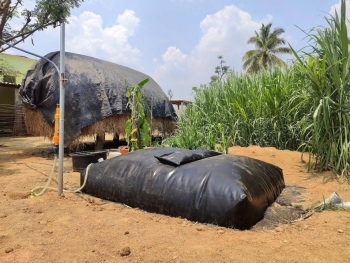
Community-based biogas production: you can accomplish this on your own at home or as a group to have a steady supply of cooking gas at your residence. Let's examine the raw materials that your bio-gas plant can use:
Cowdung from cowsheds or road side; Food waste from house hold food “ leftover or spoilt food, vegetable extracts, peels and shavings; Grass and weeds from compounds and comunidade lands.
While cowdung and food waste may be limited, grass and weed are abundant in our compounds. Growing a bamboo can give you unlimited supply of leaves on a daily basis which can be used for bio-gas production. If you are worried about the grass in the comunidade land, do not burn it but employ some people or get together as a community, collect the grass and use it for bio-gas as your abundant supply of raw material, the thing that you used to burn thinking it’s a waste becomes the source of your fuel. The grass or weeds can be also collected during the rainy day or normal days, a household with just two individuals can produce wet waste which will be around 1kg to half a kg depending on their consumption pattern.
Let us examine what are the possible benefits of bio-gas, the gas produced is light and you will be saving up on paying the cylinder charges.
If done at an individual household level, the cost can be recovered in just 15 months, this is the same amount that you pay to purchase a cylinder per month. Consider this a 15-month arrangement. But buying a cylinder is a recurring process, here you have a constant source of fuel for your entire household if you switch to bio-gas.
It reduces soil and water pollution; you may wonder how? Just imagine you are sending unsegregated garbage to the land fill, what happens next the organic material (food waste, vegetable waste or anything that can decay) which is a black gold mixes with plastic and hazardous material, they gradually loose water and mix with poisonous substances, enter the landfill areas and ultimately make way into our aquifiers, the leachate which is poisonous enters into your wells, springs and rivers and contaminates them and we end up drinking such water. Just imagine your young ones consuming such water which is poisoned by us.
Once the raw material in your bio-gas unit is completely utilized it becomes manure which you can resell or use in your kitchen garden as compost. You can completely do away with chemical fertilizers which change the composition of your vegetables and your body assimilates the harmful compounds from such vegetables and causes other health issues.
Apart from the above benefits it also prevents the households from letting smoke accumulate in their own homes as well as in the neighbourhood.
We hear a lot about stubble burning and the pollution it causes, bio-gas is one of the best solutions. If only all knew and if only more people would come forward to adopt this method, the solution would no longer be a problem. It may be a long way to reach the goal of net-zero by 2070, but Goa government can be a pioneer by stepping in and making the adaptation of these methods mandatory for all and providing training on how to manufacture the unit locally. Half of your garbage collection problem will be resolved at source. Rest of it can be still utilized to create upcycled and recycled products.