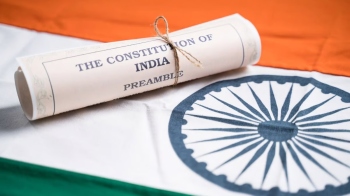
The present murmur to change the Constitution can’t be understood without understanding Deen Dayal Upadhyay who holds a very high status within the Hindutva fold. He might not be well known outside the RSS and BJP circles but within the Sangh Parivar he is treated as one of the great icons who helped shape the party and provided a certain ideological clarity. He was originally a pracharak of RSS who was loaned to Jan Sangh when the RSS, after the assassination of Gandhi found itself isolated and helpless. It then dawned on the RSS leadership that without political muscle power, the civilisational project of Hindutva would not go far and politics might strangulate RSS if it did not have enough support outside the four walls of the RSS. The then RSS chief M S Golwalkar formally gave his consent to Syama Prasad Mookerjee to form a political party which later was called Jan Sangh. BJP is the new avatar of the same Jan Sangh.
Deen Dayal Upadhyay till his death played a pivotal role, first as a general secretary (organisation) and later as the party president. In 1968, he was found dead near Mughal Sarai railway station. His death remained a mystery. A lot of conspiracy theories were propounded but nothing concrete could ever come out. He was a simple man with meagre necessities but he was one of the very few within the Hindutva fold well versed with not only the Indian knowledge system but also aware of the western world and its philosophies. Following the tradition of the RSS, he was of the view that after Independence India should have been inspired by the Hindu tradition and the Hindu way of life should have been imbibed in our political and constitutional ethos and the constitution should have been constructed accordingly. The constitution which was created by our founding fathers was never liked by the followers of Hindutva. Neither the Hindu Mahasabha leader Sawarkar nor Golwalkar were in agreement with the constitution. Both the leaders were of the opinion that there was nothing Indian in the Constitution. Upadhyay was in agreement with them.
Upadhyay propounded a theory of ‘Integral Humanism’ which was an alternate vision for India, which claimed to have been inspired by the great Hindu tradition and believed that India can attain its past glory only by following India’s civilisational values and its thought process.
Deen Dayal Upadhyay held a four day lecture series in Pune in April 1965. In this lecture he elaborated his concept of Integral Humanism and through that he not only presented the critique of the Indian constitution and inspiration for the constitution and the way the politics and society functioned after independence but also presented the alternate vision of how the country should be governed and daily life should be run.
Upadhyay attacked the Constitution on two counts ” secularism and federalism. In his opinion both the concepts, which are the basic feature of the Constitution, do not reflect the basic nature of the nation. He said that the word secular was borrowed from the West, and in the Indian context it was not needed. He said that the state can’t be without dharma so to call the Indian state dharma-nirpeksh was not right. He opined that the job of a state was to create a system which was run according to the dharma. In this context State and dharma-nirpekshata are contradictory. Then he prophetically announced that state could only be ‘Dharma Rajya’. Though he clarified that this ‘Dharma Rajya’ is not a theocratic state like it is understood in the west, but in his lecture he insisted that unlike in a democracy where sovereignty lies with the people, Dharma will be sovereign. This is a problematic idea. What is more disturbing is that he says, “Dharma is bigger than people, parliament, majority, judiciary and all other institutions and these have to follow the dictates of the Dharma because Dharma of the nation is bigger than the rest.”
Though he does make a distinction that Dharma is not religion. And in ‘Dharma Rajya’ every religion will be free to practice and pursue their religious beliefs unlike in a theocratic state in which only one religion is supreme and others have to function in restrictive ways. But the question is who will define “What is Dharma”. Upadhyay is silent on this issue.
He is also opposed to the concept of federalism which defines the relationship between the centre and the state, and between the states. He believes that basic civilisational ethos of India is ‘unity in diversity’, the concept of federal India goes against the belief of ‘unity in diversity.’ The Nehruvian thought process also believes in unity in diversity but it makes a fine balance between unity and diversity. For Nehru unity organically connects diversity into one common whole. But Upadhyaya thinks that Nehruvian concept of unity in diversity makes India a collection of states which is opposed to the unity and integrity of India. He says, “In this concept, there is no imagination of a live consciousness of Bharat Mata. According to the first article of the Constitution, India that is Bharat is ‘Union of India’. That means all Matas like Biharmata, Bangmata, Punjabmata, Kannadmata, Tamilmata etc will form Bharat Mata. This is a ridiculous imagination.” He says, “That our Constitution should not be federal but unitary.” In a unitary framework, states will have little say, and will function at the mercy of the centre. Will it be acceptable to the states?
It is this conceptualisation of Upadhyay which is frightening. After its humiliating defeat in 1984 the BJP formally discarded ‘Gandhian Socialism’ and adopted ‘Integral Humanism’ as the guiding principle of the BJP and its governments. It is in this context that the murmur, that if BJP under Modi gets a third term then it could strive to change the Constitution, should alarm every thinking person.
-- FPJ