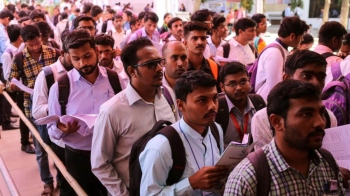
Goa has one of the highest per capita incomes (around Rs 7 lakh) and lowest poverty (less than 1%) in India. The State has an impressive bank deposit of over Rs one lakh crore (around Rs 6 lakh per capita) and strong secondary sector with a share of over 50% in the GSDP. In spite of these strong fundamentals, Goa’s unemployment rate is estimated as high. As per the Periodic Labour Force Survey (PLFS) 2025 Annual Report released by the Ministry of Statistics and Programme Implementation, Government of India, the unemployment rate (age group 15 years and above) in Goa is estimated as 8.3%, which is the second highest in the country next to Andaman & Nicobar Island (10%) as against the national average of 3.1%. In contrast, bigger states with low per capita income and high poverty rate have reported lower unemployment rate like Bihar (3.8%), Madhya Pradesh (1.5%), Uttar Pradesh (2.7%) and Rajasthan (4.3%).
Goa’s high unemployment rate estimate as per PLFS has nothing to do with the number persons registered on the employment exchange. The PLFS is based on a uniform national methodology introduced in the country in April 2017 to estimate the key employment and unemployment indicators. Being a sampling technique, it is more reliable at macro level for large area and population and prone to high statistical errors for the areas with small population. In the PLFS 2025, while the sample size for the entire country was 2,70,472 households, the sample size for Goa was only 672 households. Therefore, the PLFS unemployment rate for Goa is based on survey of 672 households. While Goa is more or less equivalent to a district of a bigger State in terms of area and population, the PLFS is designed for a reliable state-level estimate, not district level estimate. The Annual Report itself says that “While using the State/UT level estimates, it may be noted that the sample sizes for smaller States/UTs may not be adequate for getting sufficiently reliable estimates for some of the employment and unemployment characteristics”.
PLFS considers a person as unemployed if they are not working, available for work and actively seeking work. In States with lower per capita income and high incidence of poverty, people have compulsion to work for subsistence, which PLFS captures as employed resulting in lower unemployment rate. But, people in Goa can afford to wait for better jobs instead of taking low-paying work or job opportunities in which they have no interest.
Over the decades Goa has created substantial job market comprising labourers, house maids, construction workers, waiters in hotels and other tourism related jobs, blue-collar jobs in industries, municipality workers etc, but they are largely occupied by the people from outside Goa as mostly Goans are not ready to take up such jobs. Goan educated youth may prefer to wait preferably for government jobs or white-collar jobs. PLFS count them as unemployed if they are seeking work but not accepting available jobs. It is also a possibility that they may be engaged in some work or underemployed, but not revealing and prefer to report as unemployed in PLFS surveys. Goa being a tourism bound economy with seasonal volatility, people may report as unemployed even if they work part of the year. Many Goans engage in informal work like small family business, rentals, homestays, freelance tourism activities may not get reported as employed in PLFS.
Many households receive income from abroad. More than 20% of bank deposits constitute NRE deposits amounting to whooping Rs 20,000 crore. Goa has very high government employment rate. About one out of every 15 persons in the population age group of 18 to 60 years is a government employee. Government employment is considered as more secured and relatively stress-free with flexible work environment. Although, more than 1.5 lakh persons are on the live register of employment exchange, registration cannot be equated to unemployment as it comprises already working but underemployed, still pursuing education, self-employed, contract workers and many not actively seeking jobs.
Goa’s unemployment is not a myth but it is a combination of underemployment, skill mismatch and shortage of quality jobs acceptable to aspiring youth. High statistical volatility, population heterogeneity and ability of the people to stay idle make unemployment in Goa look perceivably high or unstable. It is not a sign of economic distress but calls for demand-based employment policy suiting Goan youth. For example, the Mopa Airport Aviation Skill Development Centre (ASDC) could be a model. The Mopa Airport Concession Agreement has mandated the Concessionaire to set up ASDC to impart required skills to local youth to make them employable at the Airport for various types of job opportunities. This has led to significant number of Goans specially from Pernem taluka getting employment at the Airport. In all sectors, similar approach may be followed while approving any business proposal with a pre-condition that Goans need to be trained and employed for all job opportunities clearly defining its implementation mechanism so that it doesn’t remain on paper.
Deeper study is required to understand and address unemployment or underemployment problem of Goa. As an example, it would be worth to study why Goans are missing from Goa’s casinos, in spite of it being provider of white-collar jobs. An employment audit of various industries and establishments may be the need of the hour to understand the extent of Goans employed and employability issues. Presently, it is also possible that information regarding availability of jobs in the private sector may not be reaching the interested youth. Therefore, evolving a real-time centralized job portal exclusively for private sector of Goa by the government and making it mandatory to all the industries and establishments to advertise vacancies on the portal may be explored.