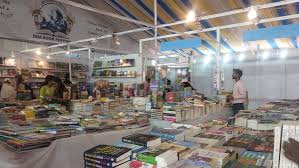
After years, the National Book Trust organised a mega exhibition for books in Goa. The crowds were good. Vast numbers of students showed up. Many exhibitors took part. Organisation was fairly good. So everything was fine, right?
Not quite. Read on... Don't judge a book by its cover and a book festival by its celebrity guests and State support alone. Last week's Goa Book Festival 2026 got attention, publicity and advertising. But then came the critiques.
One comment online read: "Noticed quite some irony there. It was the Goa Book Festival yet no significant effort was made to promote local Goan authors. With the exception of one small stall, there were no stalls that sold Goan literature. My students... were given Marathi books as takeaways. Volunteers were giving away free Marathi newspapers along with other literature. Struggled to see what was Goan about the event with the exception of Goan aesthetics in their decoration."
Someone else wrote: "I do not understand how sessions by/of film or television industry figures (unrelated to literature, books or anything such) add to a book festival. I was surprised to find the names of TV figures Amol Parashar and Avika Gor in the lineup of speakers, maybe selected just for their name and face."
So, is it unfair to expect greater local participation in a State-funded event? Are we being too parochial by critiquing outstation participation? Should the choice of partners be more carefully done? Or are we just seeing diversity in intensely multilingual Goa being shoved to the side? First things first.
India's Central government publishing body, the National Book Trust, is tasked to promote reading and producing affordable books in multiple Indian languages. It's supposed to develop a reading culture nationwide, support children’s literature, organise book fairs and literary events. Thus, promote knowledge and education.
Yet, it has been ages since NBT organised a major book fair in Goa. It was to hold one in 2012, and announced plans at the Patto promenade. But that was suddenly, and without explanation, cancelled at the eleventh hour.
But, to give the NBT its due credit, it held some useful courses in book publishing in Goa, way back in 2005 and 2012. Some like this columnist have been beneficiaries of those ultra-reasonably priced training. (Just Rs 500, with experienced publishers flown in, and lunch served daily!)
Surely, NBT could do more in Goa; including making its books (some are useful) available in Goa.
This time round, the NBT held the Goa Book Festival in association with the Infinity Foundation, a newish organisation, headed by Kiran Thakur. This editor's Tarun Bharat has long been an influential player in the Goa Marathi newspaper segment.
The "local" partners, besides the Government of Goa, included the Samarth Yuva Foundation, headed by Rajash B. Pande. The politics of the partners obviously would shape the Festival; and this is exactly what happened.
If you want books to be well read, let the tastes of the audience define the market. To imagine that people are going to read just because they are force-fed a certain type of content, or the ideology of the party in power, is akin to living in a fool's paradise.
Of course, multilingual Goa has space for Marathi too, nurtured in its primary schools and newspaper readership. But to allow a 128-million-strong neighbouring State's books sector to overwhelm Goa by its sheer publishing numbers is short-sighted, to say the least.
There is another reason why organisers need to choose partners carefully. In the past (in 2015), another festival was organised in Goa, the childen's book festival, Bookaroo.
Probably because the local partners were a newspaper group, the other sections of the media hardly gave it any publicity. Thus died what could have been a very useful and well-organised children's book festival. There was a poor response. The festival did not return to Goa thereafter.
Much is expected in terms of openness in organising such festivals, local participation, consultation in planning the same, and making such events representative of all.
During the event, the NBT also called for a 'publisher's meeting'. Its focus was to discuss the issue of ISBN numbers, which publishers, booksellers and libraries use to track, catalogue and sell books effectively.
Problems over issuing ISBNs were felt strongly around 2017. Since, many issues have been solved, after it was taken up even internationally. A few minor glitches remain on the isbn.gov.in site; but publishers and authors can get ISBNs more easily now.
But publishers face more important issues, which officials are unwilling to talk about. The 18% GST charged on printing services and paper weigh heavy on publishers, readers and book prices.
Hardly any country worldwide taxes its book inputs so severely. Just before the recent GST rationalisation, indie (independent) book publishers raised the issue with New Delhi, but nothing came of it.
Organisations like the NBT can also help Indian publishers by building a Catalogue in Publishing or a Books in Print service. The latter database would make it easier for readers, librarians, booksellers, researchers and schools to discover what titles are currently available, in which languages, editions and formats, and from which publishers or distributors.
The CIP (Cataloguing-in-Publication) data helps to provide bibliographic info inside a book, for libraries and distributors to quickly classify, catalogue and process it.
Book exhibitions like the one Goa recently saw remind us that there's much we need to be doing for books to reach readers.