As a child, I had a bizarre fear of statues and experienced a creepy feeling looking at those static, stoic, dark giants carved in rock or cast in metal. Years later I found the basis of my dislike for statues, in Psychologist Edward Tronick’s classical ‘Still Face Experiment’; where he demonstrated that infants withdraw and turn away from an expressionless, non-responsive face of their mother!
The only time that I made an exception to my acquired ‘automatonophobia’ (fear of statues) is when one among the friends shouted “Statue…!” and the rest froze without movement and with fixed gaze. Of all the statues that I know of, the one that has left a deep imprint in my head and heart is that of ‘The Happy Prince’; a beautiful touching story by Oscar Wilde of a benevolent statue embellished with precious stones and gold, and a kind swallow bird. That surreal narrative of the extraordinarily kind statue and unfaltering friendship of the bird moved me much. During my visit to European countries; I did observe that most of their statues clearly wear a melancholic expression that gets highlighted by the cold grey weather.
During my growing years in Goa, public spaces were not crowded by statues; barring those of a few famous personalities like Abbe Jose Custodia Faria, the famed hypnotist and priest of Goan origin. Ram Manohar Lohia’s role in galvanizing the Goan masses against the Portuguese was commemorated in a statue at Lohia maidan in Margao, while the one-eyed Portuguese poet LuÃs Vaz de Camões resurrected in marble at Old Goa became the bull’s eye for the irate freedom fighters in 1980.
During my college days in 80s, the twin bronze statues of men holding a torch at Miramar circle grabbed my attention on daily basis, just as many stole a glance at the titillating mermaid sculpture in the garden near the Adilshah palace in Panaji. But nothing matched the romantic allure of the much misinterpreted (to the enchantment and emotions of the tourists and benefit of the state) twin statue of Dona Paula.
The Gandhi circle in Old Goa has a statue of the ‘Mahatma’ that gets its annual cleanup and attention in October, and offers a symbolic protest site round the year for politicians and activists of all affiliations, hues and motives.
During Goa’s post-liberation phase until 1977, with Maharashtrawadi ideology riding the wave of electoral success, the valour and charisma of the Maratha king Shivaji Raje Bhosale found its way from the history text books into the Goan psyche and public ethos. Statues of Chhatrapati Shivaji were installed in many prime locations across the state and continue to evoke a strong sentiment till date from a section of Goan society. We do also have a few statues of Goa’s first Chief Minister Bhau Saheb Bandodkar in some strategic locations; balanced by two of Jack Sequeira, the ‘father of opinion poll’ whose efforts helped us retain ‘Goenchi Asmitay’ against the push for merger.
At the Institute of Science where I pursued my higher studies in Bombay, immediately inside the main entrance of the building was a marble statue of its founder, Lord Sydenham; the then Governor of Bombay and a Fellow of the Royal Society, London. This statue offered a regal backdrop for our annual class photograph, yet my heart pounded vigorously every time I walked past that imposing statue late in the evening after descending down the wide main staircase.
In our country statues of Mahatma Gandhi and Babasaheb Ambedkar are ubiquitous, and rightly so due to their immense contribution to national freedom struggle and Indian constitution respectively. But in some socio-politically volatile states of our country where tempers run high and sanity disproportionately low, statues become the trophies of electoral battles. The gullible get enticed with installation of high rise statues, whose height is mistaken for religious pride and patriotism. The marginalized and socio-economically diminutive constituents see themselves as vindicated and victorious in the height of the tall statues. KCR inviting dalits from 119 assembly constituencies in Telangana for the inauguration of tallest statue of BR Ambedkar at 125 feet clearly underpins the electoral value of statues in caste ridden politics.
Leaders also seek to consolidate religious sentiments, and hoist nationalist pride by erecting statues of astonishing dimensions at whopping costs. Intended construction of world’s tallest statue of Lord Ram on banks of Sarayu River at Ayodhya under CM Yogi’s regime and one announced by Home Minister Amit Shah in Telangana are pointers to electoral advantage of statuary in rising majoritariansim.
There are politically defunct leaders like Mayawati; who during their rule have sanctioned impressive budgets to sculpt and install statues of their own selves, their mentors and electoral symbols, in a quixotic attempt to leave their legacy. We also have hero-worship manifesting into statuettes of the men of cinema and sports, housed in dedicated temples.
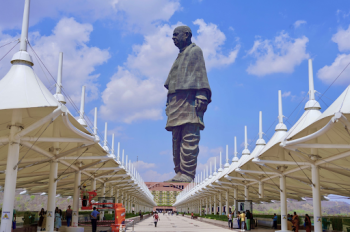
Recently I had the opportunity to visit the world’s tallest ‘Statue of Unity’ on the banks of Narmada at Kevadia in Gujarat. This brilliant engineering marvel immortalizing Sardar Vallabh Bhai Patel in bronze at a height of 597 feet dwarfs the much hyped ‘statue of liberty’. While there is criticism from political opponents that this statue is an attempt by Prime Minister Narendra Modi to rewrite history and wipe out Nehru’s legacy; the sheer magnitude of the effort and associated paraphernalia surely gives Indian visitors, pride and patriotic surge at its best.
Of late in Goa, statues have become political weaponry and instruments of communal friction. In the last one year the state has witnessed a see-saw of installations and vandalism of statues, aggressive sloganeering and mob fury.
Notwithstanding their historical, cultural and political contexts; to me statues exude calm, yet evoke a feeling of loneliness, captivity and forced antiquity. I firmly believe that we can have statues of leaders, but leaders should not be like statues; metal-skinned, unfazed and aloof…