


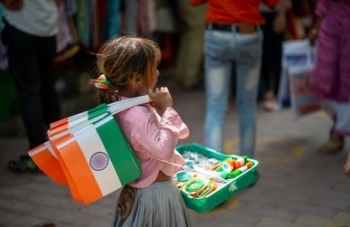
Traffic signal junctions as a custom have come to mean business for many roadside peddlers who begin soliciting buyers no sooner the lights turn red.
Usually they are cheap accessories that may find use within the four-wheelers like decorative items, mobile holders, sun-visors, etc. Then there are a few who begin cleaning windshields and accepting whatever money is given after the job is done.
But the sight of a couple of children hurriedly assembling a few assorted items which tend to act as their props as they begin performing antics in the middle of the road to the rattling of a drum by an elder gent or lady, with another child going around collecting tips from the commuters when the lights alternately change green and red, is what continues to stay in one’s mind for quite some time after moving on from the junction.
A scene that is as pitiful as it is distressing; it does not however mask the stark reality that this is that face of poverty in the country which invariably makes adults out of children even before they have realized what life is all about.
At an age where they should have been going to school, they are already lugging the responsibility of feeding the family. What does childhood mean to such poverty-stricken children?
According to a UNICEF report, children are more vulnerable to the effects of poverty. Children who grow up impoverished often lack the food, sanitation, shelter, health care and education they need to survive and thrive.
Some children are compelled to work to support their families, depriving them of their rightful childhood. Girls barely into their teens working as maids in various households are a very common sight in urban residential dwellings.
Being born into a family living on the breadline means that the child is destined to a life where he or she will, with other members of the family, soon be striving to make ends meet.
Child hawkers selling items in traffic and along busy streets are not unusual either. The other day I had a small girl selling dusting cloths approaching me and literally pleading with me to buy at least one from her as she had not eaten anything since morning.
Often I have wondered how much they would make at the end of the day even if they were to sell all their wares, which would rarely be happening. And what would their share of the sale be!
Spending several hours on the street under the scorching sun, trying to attract customers to buy their products, child hawkers are indeed subjects of pity.
Children are arguably the most vulnerable segment of our population.
Taking serious note of children being forced to sell trinkets and toys at traffic signals and street-corners, the High Court of Karnataka had directed the stakeholders to meet and suggest ways to rehabilitate and provide such children education.
The court was hearing a petition of a child rights foundation from Bengaluru. The court observed that forcing children to sell toys and other things at traffic signals is a violation of their fundamental rights under Article 21A (Right to Education) as well as Article 21 (Protection of Life and Personal Liberty).
Generally, Child Rights Foundations across the world work for the fundamental rights of the child to health and health services, quality education, protection from all forms of violence and harm, and the rights to participate as a citizen of the country. But their success quotient leaves a lot to be desired!
However, according to reports, the dismal status of our children due to violence and abuse is not due to lack of a child rights framework, or a lack of laws within our country. Yet we have not been able to protect children against exploitation.
For instance: Child Labour (Prohibition and Regulation) Act, 1986, amended in 2016 as Child & Adolescent Labour (Prohibition and Regulation) Act, 1986, completely prohibits employment of children below 14 years of age in all occupations and processes.
Nevertheless, the maximum number of young maids employed in urban dwellings by the more affluent in the society are children below fourteen years of age.
Various acts promulgated in the country which underscores the importance of educating and nurturing children into successful individuals is more of a utopian thought than anything pragmatic.
In case of families pushed into the brink of despair where only the active participation of each and every member of the family - their ages notwithstanding “ matters for its sustenance, alleviating their hunger pangs gain precedence over everything else.
An instance where the family’s sole breadwinner was a girl-child barely ten years old paints a very gloomy picture of the whole scenario. Besides having adverse effects on her health, the child can only rue her lost childhood.
Moreover, how could these children be made to focus on their education for a better future. Wouldn’t the thought of studying and educating oneself be farthest from their minds in these situations?
While there have been stories of academic excellence coming out from dreary settings wallowing in poverty, an equal number of tales that highlight the abject penury and the dismal conditions that these children live in shades a very drab picture of the proceedings.
It is not that there has been any dearth of children wishing to break the shackles of ignominy and an uncertain life that they find themselves encumbered with due to the lack of education and opportunities!
The threat of these children taking to a life of crime cannot be overlooked either. Juvenile crime is on the rise and could well be seen as a direct consequence of lives spent in unhealthy socio-cultural environments.
For every single child that escapes the rigours of an unproductive existence, there are several others who are slaves of a demanding life where all other considerations just get pushed away into oblivion, with survival remaining the sole aim.
Let us spare a thought for the ordeal of these underprivileged!


