


The other day, I was at a musical show. Enjoying myself, and trying to record the musicians from up close. Suddenly something strange struck me. Every few minutes, some politician or the other would be lauded and thanked for helping to make the event possible.
Really? Are we so dependent on this class of good and well meaning folk? Or, does the system simply make us helpless and dependent on them? Do we want cheap short-cuts? Does our life, our entertainment, and much more depend on them overwhelmingly? Are they indeed helping to make things worse for us?
A few moments later it struck me. Not just entertainment, but for so many other things, we are dependent on this charming set of folk. Or at least, we are made to feel so.
On the sports field, our games and sports are filled with them. Things had reached such a state of affairs, that way back in 2012, a politician himself, Vijai Sardessai, called for a stop to this nonsense. Vijai called for a ban on MLAs heading "sports bodies", as reported in the media then.
Occasionally (and too infrequently), this issue comes up in other forms. You can read editorials titled "On the mat: On politicians heading sports bodies.... Politicians in charge of sporting bodies create a stifling environment." (The Hindu) Indian wrestlers raising issues of sexual harassment have been dramatic, even as the ruling party in New Delhi has simply refused to take action.
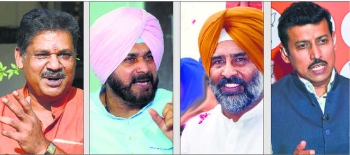
But this is not a one-way street. The field is very incestuous. Things get worse when sports-persons graduate into becoming politicians. Nafisa Ali, the national swimming champion, has been in the Trinamool Congress. Cricketer Kirti Azad joined the Congress, then Trinamool. Cricketer Azharuddin was elected a Congress MP, and stayed so even while facing allegations of match fixing.
Chetan Chauhan batted for the BJP. There are so many other sportspeople who shamelessly used their fame to support one or the other political party. No prizes for guessing where these sportspersons have been rushing to in recent times.
On this list are former pro footballer Prasun Banerjee, cricketer-athlete-swimmer Bhavya Bishnoi, former swimmer Bula Choudhury, shooter-basketballer Kalikesh Narayan Singh Deo, cricketer Gautam Ganbhir, hockey gold medallist Aslam Sher Khan, cricketer Manoharsinhji Pradyumansinhji, footballer Wangnia Pongte, Olympian shooting medalist Rajyavardhan Singh Rathore, cricketers Laxmi Ratan Shukla and Navjot Singh Sidhu, middle-distance runner Jyotirmoyee Sikdar, clay pigeon trap and skeet champ Karni Singh, hockey Olympian Pargat Singh, hockey ex-captain Dilip Tirkey.
Some of these ex-sportsmen get to head sporting bodies, further politicising them. But you don't even need that skill. Before me is a 'Caravan' magazine, with its cover story titled 'Shah's Playground: BJP's Control of Cricket in India'. It deals with the ascendance to power of Union home minister Amit Shah's son Jay Shah at the helm of that amazingly wealthy body.
In Goa, when the BJP used every psychological trick in the book to come to power in 2012, a number of Salcete sportspersons helped it attain this goal. But the BJP is not the only party who has made use of sportspersons for its political agenda, as seen above. Or from what we know to be true.
You wouldn't guess the sporting links of many of our politicians. For instance, Narendra Sawaikar's with athletics, Kiran Kandolkar's with archery, Chandrakant Kavlekar's with atya patya! Ramakant S Angle's with basketball. Rohan Khaunte with boxing, Nilesh Cabral with chess, Girish Chodankar with kho-kho, Vishwajit Rane with throw-ball, Lavu Mamlatdar with mallakhamb, among others!
If you're wondering what malakhamb is, it's a form of ancient martial arts, a training aid for wrestlers and "ancient warriors". Churchill Alemao's links with football go back too long to warrant discussion. He has been consistent with that sport, but the politics and economics behind his involvement has also been noted by others who know better.
This list is not even complete.
As far as education goes, just don't talk. You could be a semi-literate politician, and you're entitled to set up colleges in Goa. But if you're a grouping or a community known for contributing to decades of educational endeavour, expect that permissions won't come easily or smoothly.
Entertainment is also filled with politicians. Not just music, but also fields like tiatr. Some tiatrists have been very blunt in their views and in amplifying the sentiments of the common folk. But at least a few have taken political sides. This is even more obvious in the run-up to elections. One has to hear tiatrists sometimes expose each other, by talking about the political biases of their "rivals".
Some time ago, while young and idealist, I would attend events organised by Goa's aboriginal communities. Soon, one realised two things. Firstly, these events were organised suspiciously close to the election season. Secondly, it was politicians who were calling all the shots and controlling the debate.
The fact is that many of the protests have had political angles to the same. Students who were demanding 50% bus fare discounts would have probably not got their goals met in the late 1970s, if the then Opposition wasn't desperate to oust the long-lasting Bandodkar-Shashikala MGP governments. Some of the protests in the 1980s got a fillip because these were conveniently targeted against then dissidents challenging the Rane regime.
About the political control of student unions, the less said the better. Today's linkages are open and shameless, in the past some believed in student independence.
Religion's links with politics we need not even go into here. This is not to criticise all. But, as long as we have some ambitious religious leaders, they are going to find politicians an easy source of getting access to what is Caesar's. Across religious lines too.
Even NGOs and women's groups can sometimes be fronts for political interests. Again, this is not a general criticism, but a few exemplary cases really do stand out strongly. We might have missed out mentioning some more of the obvious.
Yes, political patronage serves everyone. Or so it seems. It helps us achieve our goal. And gives us short-cuts. But, in reality, it only makes the people helplessly dependent on a small clique that can control everything. If we fall for it, we should not start wondering why our sporting standards keep deteriorating (except when beyond the radar of politicians). Or why our standards fall in so many fields. Goa can do better, as its people have so well demonstrated in so many diverse parts of the globe.


