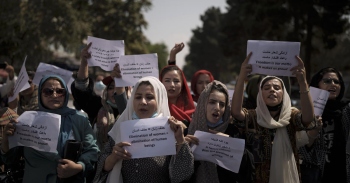
‘Reopen education and swiftly reverse the policies that restrict education for women’ urged the 15-member UN Security Council on the suspension of access to universities for women and girls in Taliban-led Afghanistan.
The Taliban have suspended education for women who were demanding full, equal and meaningful participation of women and girls in Afghanistan. Calling the act an ‘increasing erosion of the respect of human rights and fundamental freedoms’ the Council expressed deep concern and has stated that this regressive act would have a significant and immediate effect on humanitarian operations in the country.
Women and girls have been deprived of their rights, including the right to education, since the Taliban returned to power on August 15, 2021. After the US-backed Kabul administration left the country and foreign forces withdrew, the Taliban widely implemented their interpretation of Islamic law or Sharia.
On September 18, 2021, the Taliban enforced a ban on secondary school education for girls within a month after coming to power. The ban that was to be temporary now appears permanent with the Taliban defending their acts. On November 9, women were banned from visiting most public parks, hammams, and gymnasiums. There have been several public floggings since then.
This week the Taliban banned female students from all universities in Afghanistan. With this kind of ban, nearly all Afghan women above the age of 12 are now barred from formal education. The faculty are not allowed to take online classes for girl students while the women are barred from working for domestic, and foreign NGOs.
Even though primary and elementary schools remained open, the ban on secondary education ensured that the ban was effectively total. Girls have been prevented from attending middle schools. The government has banned girls from attending high school and imposed gender segregation and a new dress code at universities. They have also banned women from applying for many university courses and this ban has come barely three months after scores of female students took university entrance exams across the country. The Taliban have banned female employees of NGOs and international organizations from going to work while the female students at universities have begun vacating their dormitories.
The trend towards restrictions on all aspects of women’s lives is disturbing and concerning. These restrictions include limitations on employment, education, public interactions and other fundamental rights such as access to justice. The ban makes Afghanistan the only country in the world where girls and women are denied access to education, public parks and gyms, require women’s faces to be covered in public and limit the number of days they can go shopping only with a male relative.
The Higher Education Minister in Afghanistan defends that the ban issued was necessary to prevent the mixing of genders in universities and because it is perceived that some subjects being taught violated the principles of Islam. Other reasons quoted for the university ban were women’s failure to observe a dress code and the study of certain subjects and courses.
The worst is that the Taliban fighters are appointed as officials and teachers at universities, despite their lack of qualifications. It would be ‘disrespectful’ for members of the Taliban to take exams to determine their academic qualifications, insists the ultraconservative Higher Education Minister in Afghanistan and insisted that a Taliban fighter’s credentials were based on the ‘number of bombs’ he had detonated and not degrees he acquired.
Education is a human right and is also essential to Afghanistan’s economic growth and stability given that females constitute almost 50% of the student community in Afghanistan. About 80% of Afghanistan’s economy is informal and dominated by women, according to the UN. Currently, the humanitarian situation in Afghanistan is very bleak given that 97% of Afghans live in poverty and 20 million people face acute hunger.
One-third of all households surveyed have insufficient income to buy the food they need, and another nearly one-third have income enough for food but no other necessities as per the second round of the World Bank’s ‘Afghanistan Welfare Monitoring Survey’ (AWMS) released on November 2022 and covering the June-August period.
By now more than two-thirds of women who were employed in 2019-20 lost their jobs and became unemployed or left the labour force. At this point, it is feared that the country could lose over $1 billion per year in contributions that women could add to the economy.
It is important to note that no country has recognized the Taliban as the legitimate governing authority in Afghanistan including Pakistan, and the UAE. Muslim-majority countries such as Saudi Arabia, Turkey and Qatar have not been kind to the decision and the G-7 group which includes Canada, France, Germany, Italy, Japan, the United Kingdom, the United States and the European Union have condemned the Taliban.
These nations have asked the Taliban to change their course while Muslim scholars and activists say gender-based denial of education has no religious justification. Yet, the Taliban policies on the rights of women, free speech and other human rights have only become increasingly strict over the past year. The Taliban have also failed to live up to their pledges to the wider international community.
India expressed concern over the ban on university education for women in saying it has consistently supported the cause of female education in the country. India has reiterated the importance of the establishment of an inclusive and representative government that respects the rights of all.
Issues like pervasive poverty, hunger and deprivation could be addressed through aid and long-term economic developmental agenda but draconian social and humanitarian restrictions will forever miss opportunities for the war-devastated country.