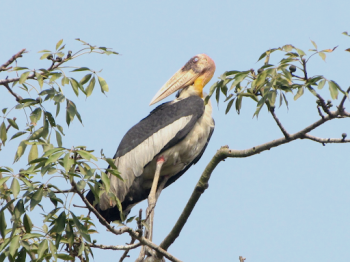
Misconceptions based on looks and habits of a species often translate into antagonism and dissent, both detrimental to continued existence of that species which otherwise may be benign and of high conservation value. The role played by people’s attitude towards wildlife has been a subject of research since Kellert’s classical study in 1980 on typology of attitudes and how they shape conservation action.
In my recent visit to the north-eastern state of Assam, I had the opportunity to test the hypothesis that a positive public opinion matters in successful conservation initiatives. This story is that of a bird that has come a long way from being despised, shunned, and driven away by locals from the trees in their backyards; to being willingly and consciously offered roosting and nesting sites by the same community, now reflecting in their prayers, and being celebrated as a global icon of community conserved species today.
Nothing has moved me after Jane Goodall’s exemplary efforts at saving the chimpanzees in Congo, as has the down to earth efforts of our own Dr Purnima Devi Barman who has made it her life’s mission to volunteer custodianship and build capacity of the local community; with incentives to protect and conserve this prima facie repulsive tall bird with scavenging habits.
Purnima affectionately called by locals as ‘Hargila Baideu’ (Stork Sister), in recognition of her seminal and sustained efforts at involving the community by changing their perception about the bird since 2007, is the beacon of hope for the last surviving population of the Greater Adjutant Stork in Assam. The bird currently ranks high in the EDGE (Evolutionarily Distinct & Globally Endangered) scores and is placed by the IUCN in the Red Listed ‘Endangered’ category, occurring in smaller congregations in Bihar and Cambodia.
Once common in north India; flocks of this bird fed on carrion, offal and even half burnt human corpses on cremation ghats, the bird is now a victim of improved sanitation, and loss of nesting habitats. Bigger and bolder in comparison with its smaller counterpart, the Lesser Adjutant (a regular winter visitor to Goa), the Greater Adjutant Stork is distinguished by its tall height, bald head and neck, a massive wedge like bill smudged with dried blood while feeding off the carcasses.
These birds roost and nest on tall trees; and often their fetid copious excreta, scraps of putrid flesh, and even their large hideous chicks fall off the nest on to the grounds. While the villagers found these inadvertent bio-missiles dropping from the nests in their backyards a reason to hate the bird, their helpless chicks were left to die in agony and pain.
Having spent her childhood in a farming village, Purnima was introduced to this bird with a stiff military gait (hence the name Adjutant) by her grandmother through songs. This early sensitization to the bird and its ecology became her life’s mission and motto, and today with her ‘Hargila Army’ of rural women, her conservation efforts have been recognized globally culminating in UN’s highest award in conservation ‘Champions of the earth’ being bestowed upon her in 2022. She’s also a recipient of Whitley Award (Green Oscars) in 2017.
So intrigued was I with this bird that has earned the sobriquet of Hargila (Bone Swallower in Assamese), that for over two months I scouted for this enigmatic bird in Assam to get a first hand understanding of its ecology and ethology. Manish Kumar Thapa, a young research scholar of Guwahati University accompanied me to the Baragaon landfill site of Guwahati, filled with an unbearable stench of garbage dumps where rag pickers and Greater Adjutants share space and resources!
Walking through sludge and heaps of urban waste, a little further we reached a part of Deepor Beel, the only Ramsar site in Assam. A small flock of four Greater Adjutants were foraging in shallow water, I took cover behind a tree and spent next hour or so, observing and photographing these beauties; overwhelmed with the thought that I was seeing the last few individuals of a globally declining population.
The same day, I visited Dadara village in Kamrup district the hotbed of Hargila Army and observed nesting behaviour of this bird, sitting under tree for hours together. It was fascinating to watch these tall heavy birds with inflated neck pouches enticing mates up in the canopy, with a loud bill clutter and an offer of twigs for nesting.
A young Assamese botanist Kanishka Ranjan Deka invited me to his native village in Darrang district for lunch and surprised me with a visit to his backyard where a single tree had five nesting storks! The bird got me hooked, and I spent time scanning landscape of seven districts of Assam looking for it.
What better way to conclude my Assam visit than to have been invited by Dr Purnima Devi Barman to her residence in Guwahati, where I was seeing her eight years after our last meeting in France for European Congress of Conservation Biology. The soft spoken and ever smiling ‘Stork Sister’ shared experiences of her eventful journey, while the citations and awards adorning her drawing room testified to her perseverance, passion and acceptance by the very same community that was hell bent on eradicating what they initially thought was an ugly bird !
I was convinced that a balanced, reasonable, patient outlook and focused sustained effort can reverse an anomaly and adjust an unjust tilt. As I left Purnima’s home being gifted with a traditional Gamusa carrying a Hargila motif, my heart and head was filled with pride for her incredible achievement.