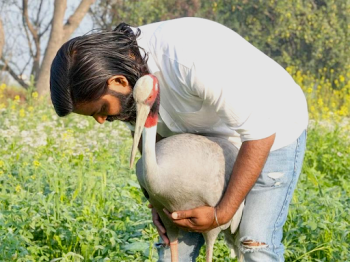
Sometimes acts of compassion can get us entangled in the knotty pitch of legislation, stirring up an ethical dilemma; to be kind or not to be! UP’s Arif Khan Gurjar’s unusual camaraderie with an injured Sarus crane that he rescued from his fields in Mandkha village of Amethi a year ago, had been grabbing attention and winning hearts on social media platforms. The ‘hero’ has now been booked as an ‘offender’, with notice of breach slapped on him.
When I first viewed a video of this remarkable bonhomie between the young bearded man and the bird he rescued, I was simply astonished. The rapport was indeed heartwarming, and clearly showcased mutual trust and acceptance. The Sarus remained in close company of Arif, and actually ate from his plate. As the young lad rode his motorcycle, the predominantly gray bird with a white crown and blood-red head flew parallel all along! The bird wiped off this villager’s nameless status and propelled him into the orbit of fame; with news channels, celebrities and politicians making a beeline to this village to witness this epitome of queer amity.
Going by the narrative, the man had shifted an unconscious bird with a leg injury from his farm to his modest residence for treatment and recuperation. Care and affection yielded results and the bird regained its health and strength to be able to walk and fly. But in the time that the bird spent with Arif, something interesting happened in terms of their bonding.
The bird bonded with his benefactor so intensely that they lived, ate and slept together, literally. The bird’s reliance and confidence on his caretaker grew so deep that Arif found it difficult to slip out of his house without being accompanied by his feathered companion. Curiously the bird did not display this confidence in Arif’s wife and children, whose attempts at approaching the bird would be met with aggression.
This saga of trans-species friendship came to sudden halt recently, when the UP forest department seized the bird and subsequently served the man a notice with intent of prosecution for unlawful possession of the State Bird of Uttar Pradesh, classified by IUCN as ‘vulnerable’.
The bird was quarantined for 15 days by the authorities at Kanpur Zoo, to rule out zooanthroponotic disease acquired if any during its stay with a human for over a year, and then released into the Samaspur Bird sanctuary in Rae Bareilly for rehabilitation into wilderness.
This ‘separation’ wasn’t viewed politely by those who had witnessed this baffling friendship, and there was a sharp resentment and backlash from one and all.
Interestingly the translocated bird strayed from the bird sanctuary only to be recaptured and currently being held in Kanpur zoo under the supervision of two veterinarians. The authorities have refuted the rumors that the celebrity Sarus is ‘depressed due to separation’.
The entire sequence of events brings to the fore a few interesting questions and musings on premises of law and ethical obligations. Arif’s impromptu action of taking custody of the injured bird from his field and offering it a safe asylum in his home for recuperation merits appreciation. Perhaps it wouldn’t be wrong if one argues that the man simply upheld his constitutional obligation and citizen's duty to promote environmental values.
In a situation where this bird of high conservation value is losing grounds fast due to poaching, nest predation and pesticides; and its populations are declining incrementally; even a single individual saved is explicitly an act of conservation, over and above compassion.
In my considered opinion, the forest authorities should view this bizarre case through a prism of environmental constitutionalism rather than the circumscribed wildlife protection act. Part IVA of the Constitution (Article 51A) mandates every Indian citizen to ‘protect and improve the natural environment including forests, lakes, rivers and wildlife, and to have compassion for living creatures’. Are these constitutional prescriptions only symbolic, hortatory and educational? Can wildlife legislation be repugnant to the constitution of the country? Can an act of care and compassion towards a non-human species be construed as crime for reasons of procedural lapse by a compassionate human?
If prosecuted, the compassionate villager may plead not guilty but only ignorant of the law that required of him to report to the authorities his act of compassion towards this live ‘government property’ as prescribed in section 39 of Indian Wildlife Protection Act.
Prima facie the accused had no malafide intentions behind holding the bird at his residence as he did not confine it to any closed space, as evident from the several photographs, videos posted in social media confirming that the Sarus walked and flew free with its care taker, and was being well looked after. It is abundantly clear that while the bird was wary about other people, it had reposed total trust and confidence in Arif.
Finally, the question remains as to why did the Sarus develop such resolute bond with the man? The steadfast fidelity with which the Crane followed Arif, reminds one of the nursery rhyme “Mary had a little lamb….and wherever that Mary went the lamb was sure to go”. A scientific mind may ask, when Mary wasn’t a sheep herself, why did the lamb follow her. Perhaps because Mary was protective towards the lamb and the latter responded to her in a filial manner.
In fact young ones of many species demonstrate this behaviour known as ‘Imprinting’ and get attached to conspecifics, other species or even inanimate object that fulfill their critical requirements. Different bird species have different imprinting windows. In case of ‘Baccha’ as Arif called the crane, the distressed feeble bird simply got imprinted on to a protective human adult and invested in filial bonding. The UP forest department may do well in knowing that birds that are human-imprinted are deemed unsuitable for release back into the wild.