Goan Christians need not spend every election attempting to persuade a majoritarian political establishment that their religious inheritance deserves permission to survive. A more fundamental proposition is available: what is lawfully and peacefully inherited is entitled to be preserved.
Hindu Goa is entitled to reclaim its history. Temples destroyed or displaced during Portuguese rule may be restored. Hindu traditions may be revived. Historical injuries may be remembered. But reclamation cannot be converted into religious replacement.
Restoration is not conversion. Reclamation is not displacement. Liberation from colonial rule is not liberation from constitutional religious freedom.
That distinction has become particularly important as the electoral vocabulary of Goa has increasingly been influenced by Hindutva and by a political interpretation of history in which the Portuguese period is presented principally as an era of Hindu suppression. In 2023, Chief Minister Pramod Sawant called for the “signs” of Portuguese rule to be wiped away and spoke of starting afresh after six decades of Liberation.
History cannot be
selectively remembered
The Portuguese Inquisition was real. It was established in Goa in 1561 and permanently abolished in 1812. Its surviving records have now been subjected to extensive scholarly reconstruction. A research database compiled from Portuguese archival material contains information concerning 8,250 defendants judged by the Goa Inquisition between 1650 and 1806, including the offences alleged and the spiritual, physical and financial penalties imposed. That history cannot be sanitised. But history also cannot be converted into hereditary guilt.
A Goan Catholic living today is not the Portuguese Crown. A Catholic church is not the Inquisition. A Christian family whose traditions have been transmitted across generations cannot be treated as a surviving instrument of a sixteenth-century colonial administration. The historical wrong therefore cannot be corrected by creating a contemporary wrong.
The Ark and politics
of memory
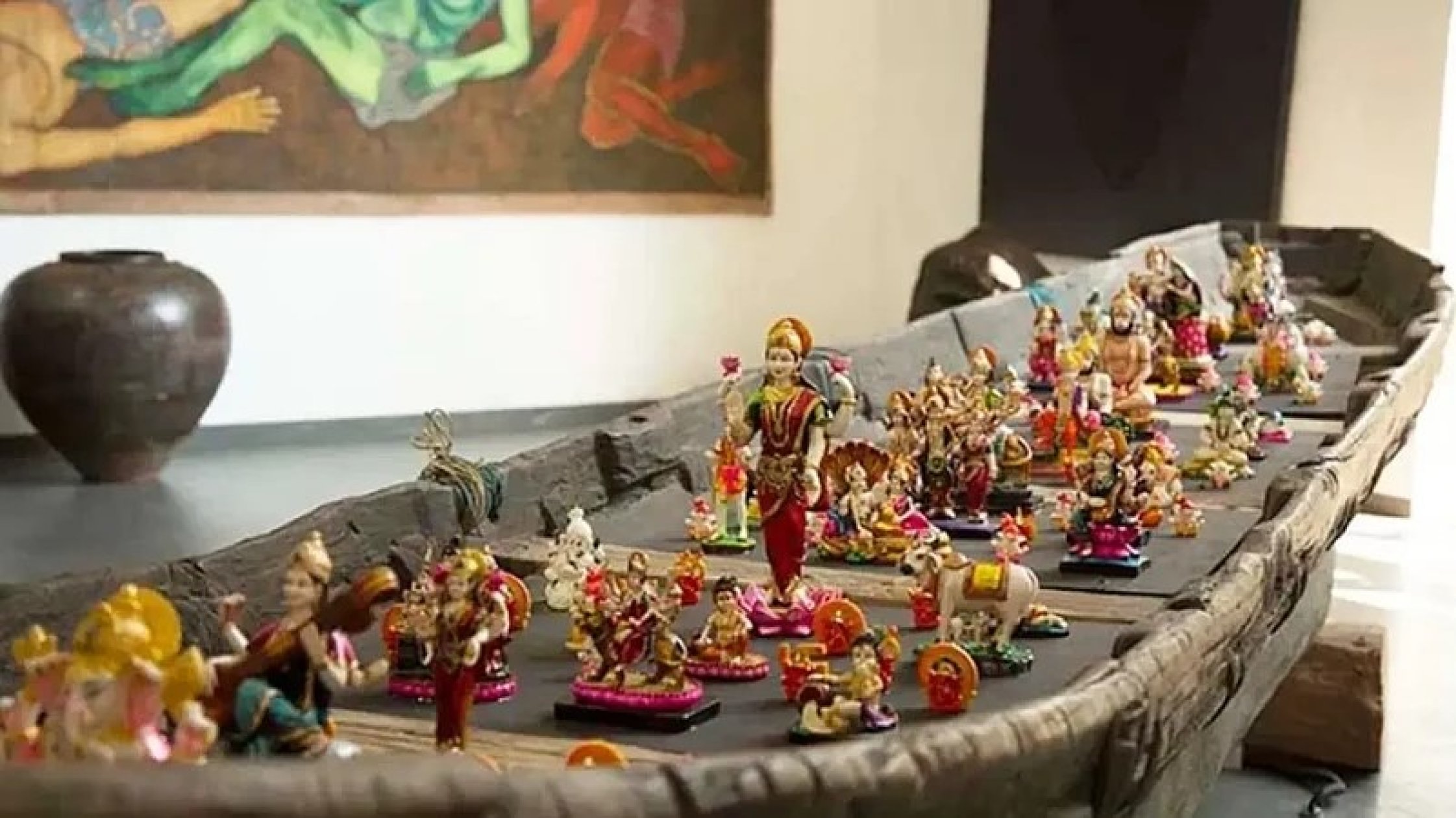
This is why the Goa's Ark installation associated with artist Subodh Kerkar carries such extraordinary significance.
The ark depicts Hindu deities being carried towards safety in the direction of Ponda, away from territories under Portuguese control. It can be read as an artistic representation of a civilisation protecting its sacred inheritance from religious and political domination. The image is striking precisely because the gods are not portrayed as conquerors. They are being rescued.
That distinction should be remembered during an election. The Hindu historical experience deserves recognition. Yet the lesson cannot be that one community's recovery must necessarily be accompanied by another community's retreat.
When decolonisation
becomes cultural replacement
The question is therefore not whether Portuguese colonial influence should be studied, criticised or removed where it represents colonial domination. It should.
The question is what is meant when “Portuguese influence” becomes sufficiently broad to encompass the living cultural inheritance of Goan Christians.
Goa's churches, feasts, music, architecture, cuisine, family traditions, names, social customs and Catholic religious practices cannot simply be classified as foreign because Christianity became deeply embedded during Portuguese rule.
The 2011 Census recorded Hindus as 66.08 per cent of Goa's population and Christians as 25.10 per cent. Those figures are more than demographic statistics. They establish that Christianity constitutes a substantial and enduring component of Goa's social composition.
The transformation of India's criminal-law nomenclature provides another illustration of the broader cultural shift.
The Indian Penal Code has been replaced by the Bharatiya Nyaya Sanhita, 2023, while the Code of Criminal Procedure has been replaced by the Bharatiya Nagarik Suraksha Sanhita, 2023. The latter expressly describes itself as legislation consolidating and amending the law relating to criminal procedure.
The substantive legislation is not simply made unfamiliar by renumbering. Much of the underlying criminal-law architecture has been carried forward, modified and reorganised rather than recreated from first principles. The significance therefore lies partly in the symbolism of nomenclature.
“Bharatiya” has been placed prominently at the centre of the names of the principal criminal statutes. The change can reasonably be understood as part of a broader political project of presenting institutions through an explicitly Indianised, Sanskritised vocabulary. There is nothing inherently unlawful about changing statutory names.
The name of a statute cannot make one religion more Indian than another.
Preservation is
not surrender
A community does not have to defeat a majoritarian political movement in an election in order to preserve its culture. Culture can be preserved through families, schools, archives, churches, associations, literature, music, language, property, religious institutions and diaspora communities. It can be preserved in Goa and, where necessary, in Portugal and elsewhere. That should not be understood as abandonment. It should be understood as cultural continuity.
Portugal already occupies an unusual place in the Goan historical imagination because of the centuries-long connection between Goa and the former Estado da Índia. That connection can be used constructively for archival preservation, family histories, cultural institutions and the protection of Goan traditions.
The objective should not be the removal of Hindus from Goa, any more than the objective should be the removal of Christians from Goa. The objective should be that neither community is required to surrender its identity to the other.
The electoral argument should consequently be brought back to a constitutional proposition. Hindu history can be reclaimed. Catholic history can be retained. Temples can be restored. Churches can remain. Colonial abuses can be remembered.
Contemporary Christians need not inherit colonial guilt. And contemporary Hindus need not inherit responsibility for the conduct of their ancestors.
That is the only durable separation between historical justice and contemporary religious antagonism. Goa was liberated from Portuguese sovereignty in 1961. Its next historical achievement should not be the liberation of one religion from another. It should be the preservation of a society in which historical reclamation does not become contemporary displacement.
The ark should therefore remain where it belongs — as a reminder of what religious coercion once made people carry away. It should not become a blueprint for deciding what another generation must carry away.