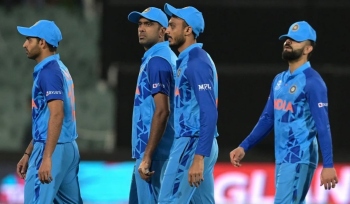
In the run-up to the ICC Twenty20 World Cup, broadcaster Star Sports ran an ad campaign highlighting India’s drought in the tournament since winning the inaugural tournament in 2007. While to the point, it seemed a bit exaggerated with the ad’s literal use of the desert setting. Now that the Indian team have been knocked out from the tournament again without reaching the final, the harsh reality has dawned on the Indian cricket fan “ 2007 is indeed a distant memory.
The perennial favourites at any global ICC event, Rohit Sharma’s men were knocked out by a far superior England team in the semifinals and the one-sided hounding has exposed Team India’s frailties. Skipper Sharma pinned the blame for the defeat on his bowlers, saying they did not turn up in the crucial match and couldn’t handle the pressure. But the humbling exit has now started a larger debate about the team’s tactics and its twenty20 blueprint; whether they even have a plan and a defined style. What brought them down was an archaic conservative safety-first template in a format that screams aggression. India had adopted the modern, no-holds-barred approach in the lead-up to the World Cup but surprisingly reverted to their old style of slow batting. Their Powerplay average of 6.02 was the second-worst after the UAE, who had the lowest scores in the first six overs. India never changed this ultra-cautious approach and ultimately paid the price for it.
The fact that there has been no progress since the 2021 World Cup where India suffered another 10-wicket hammering at the hands of arch-rivals Pakistan, shows the team's think-tank has failed to adopt a plan that delivers. Curiously, the teams that played these games were largely the same except the forced exclusions of Jasprit Bumrah and Ravindra Jadeja. The blame thus squarely lies on the selection committee, which has not shuffled the pack to bring in dynamic T20-suited players like Prithvi Shaw, Ishan Kishan, Shubman Gill and Sanju Samson into the team.
Questions will also be raised about Rohit Sharma’s captaincy and his place in the side itself. Coupled with other opener KL Rahul’s lack of impact, Sharma’s run of low scores and the dismal performance against England cost India dearly. Also, it is staggering that the x-factor of Rishabh Pant remained on the bench for almost the whole tournament as the Dinesh Karthik experiment didn’t materialise. Another dubious decision was not giving an impact player like Yuzvendra Chahal a single game in the tournament. India’ bowling lacked the cutting edge in the absence of an injured Jasprit Bumrah but the team management also failed to use the available resources smartly.
So what’s next for this team? It’s time to set a new template with a set of specialist players keeping an eye on the next T20 World Cup. Their last success of 2007 was a result of infusion of fresh blood in the team as seniors like Sachin Tendulkar and Rahul Dravid stepped aside. One can expect a similar personnel change as the Indian team decides on a reboot plan.
Boost to I-League
The announcement that the I-League champions of the 2022-23 season will earn a direct entry into the Indian Super League without paying any fees, has the clubs buzzing. This signals the implementation of the roadmap recommended by the Asian Football Confederation in 2019 and makes the struggling I-League more relevant.
A competitive I-League adds to the strength of the Indian football ecosystem and will give aspiring teams a chance to fight their way into the topflight. However, there is a caveat as the AIFF insists that the I-League winners must complete the club licensing criteria to be eligible to make the step-up. The decision though is an important first step for Indian football and will make the two-tier league system more exciting.