


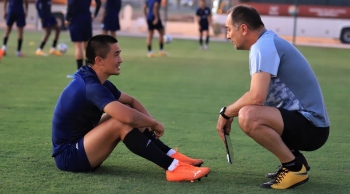
 The Blue Tigers and coach Igor Stimac (with captain Sunil Chhetri in the photo) have come under scanner after an atrocious campaign in the SAFF Championship. Captured by : AIFF
NEW DELHI
The national team's performance is often a fair reflection of any sport's growth in a country. By that yardstick, it won't be an exaggeration to say that Indian football has regressed in recent times.
The solitary-goal win over Nepal in the ongoing SAFF Championship on Sunday is an aberration in an otherwise hopeless run marked by the team's inability to eke out victories even against nations it had dominated in the past. In a tournament in which the country has won a record seven times, India found itself on the verge of being knocked out after two successive draws against lower-ranked Bangladesh and Sri Lanka.
The struggle for survival in the regional event tells a lot about which direction the team is headed. Perhaps, even the win against Nepal wouldn't have come, had it not been for Sunil Chhetri's 82nd-minute strike.
It is true that alongside the national team's graph, a solid youth development programme and a vibrant and competitive league structure are equally important towards holistically developing the sport. However, with the men's team hitting the lowest of lows in the SAFF tournament in the Maldives, the senior side and its head coach Igor Stimac have come under the scanner.
But before the powers that be of Indian football try their hands at resuscitating it from its present moribund state, they would do well to do two things: shun their top-down approach for a bottom-up approach, and recall former head coach Bob Houghton's scathing observation.
The All India Football Federation's top-down approach, which involved bidding for FIFA events, hosting them amid much fanfare, and basking in their organisational success, appears to have failed miserably in raising the standards of the national team of a country that has been showered with sobriquets such as ''sleeping giants'' and ''passionate giants''.
With far fewer resources and infrastructure than India, teams across the world have improved by leaps and bounds. To cite an example, Vietnam is currently playing in the third round of the 2022 FIFA World Cup Qualifiers and a few years ago, Syria found itself on the verge of qualifying for the showpiece in Russia.
As far as some other Asian teams are concerned, the likes of South Korea, Japan, Iran, and even Iraq have marched ahead, even as India slipped at various stages after competing on even keel against the best in the continent. Thoughts of reaching the heydays of the 1950s and 60s -- when the country won two Asian Games gold medals besides competing in the Olympics -- seem far-fetched at the moment.
About two years before his unceremonious exit in 2011, a miffed Houghton had remarked: ''You can remove the coach and you can bring Guus Hiddink or Jose Mourinho tomorrow and you will still be (ranked) 140 (then).'' More than 12 years ago, Houghton's frustrations were aimed at those in charge of the game in the country.
And while there is no doubt there has been an improvement in infrastructure and increase in resources, over a decade after the Briton's remark, the senior national team's utter lack of success remains a major cause for concern. Quick-fix solutions will not take Indian football anywhere and the current dispensation must realise that only hosting big FIFA-sanctioned events would not mask the problems facing the sport.
It's also a matter of great concern that the sport has not found a worthy successor to Chhetri, who at 37, is in the last leg of his glorious career. But ask the experts, and they are certain that there is no dearth of talent in India. They are not off the mark. For the uninitiated, a glance through the archives of Indian football would be enough to understand why they remain optimistic.


