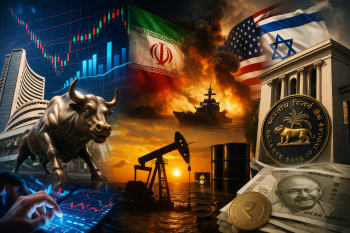
Indian stock markets finished higher on Thursday despite sharp swings during the day. After a steep fall in early trade, key indices recovered strongly, with the Sensex and Nifty ending slightly up. This marked their second consecutive gain in the new financial year FY27.
Going forward, markets are expected to remain volatile and driven by global events. The near-term trend will largely depend on developments in the Middle East, especially the situation around the Strait of Hormuz. Any prolonged disruption could push crude oil prices above $100, increasing inflation and putting pressure on the current account, while also keeping investor sentiment cautious.
Here are five factors that may influence the market on April 6:
1. Iran’s deal deadline approaches
Tensions between Iran and the US-Israel alliance continue to rise, with leaders warning of further escalation. As Iran nears the April 6 deadline set by US President Donald Trump for a peace agreement, he has warned of serious consequences if Iran does not comply, including reopening the Strait of Hormuz. In a post on Truth Social, Trump said that time is running out and strong action could follow within 48 hours if demands are not met.
2. Crude oil remains elevated
Oil prices have surged sharply in 2026, with Brent crude recording a steep monthly rise of about 56% due to increasing tensions between the US and Iran. Prices briefly crossed $109 before easing to around $106, while WTI crude moved above $111. Concerns over supply disruptions and rising geopolitical risks have supported this rally.
The situation in the Middle East has disrupted shipping and energy exports through the Strait of Hormuz, a key route between Iran and Oman. Around one-fifth of the world’s crude oil and liquefied natural gas passes through this narrow passage daily, making it extremely important for global supply.
3. Continued FII outflows
March saw heavy selling by foreign portfolio investors (FPIs), with outflows reaching Rs 1.22 lakh crore ” the highest ever for a single month. This was driven by several factors, including geopolitical tensions, rising crude oil prices, a weakening rupee, and a stronger US dollar.
However, this selling has helped correct valuations in Indian markets, making some sectors more reasonably priced. A return of FPI inflows will likely depend on easing global tensions and a fall in oil prices.
4. RBI steps support the rupee
The Indian rupee strengthened sharply against the US dollar on Thursday, recording its biggest single-day gain in over 12 years. It rose 1.8% to close at 93.10 compared to the previous close of 94.83. This came after the Reserve Bank of India introduced stricter rules on offshore derivatives to prevent further weakening of the currency.
The RBI has restricted banks from offering rupee non-deliverable forwards (NDFs) to clients, though regular foreign exchange contracts for hedging are still allowed. These measures have affected a large global market and are seen as some of the strictest controls in recent years.
5. Weak technical outlook
The Nifty is currently holding near the 22,700 level, but the overall trend remains weak. A fall below 22,300 could increase selling pressure and push the index towards the 22,000“21,800 range, which is an important support zone.
On the upside, the 22,800“23,000 range is an immediate resistance level, followed by a stronger zone between 23,200 and 23,500. A sustained move above these levels is needed for a stronger recovery. At present, momentum indicators suggest limited strength in the market.
The Sensex is stabilising around the 73,300 level after recent volatility, but the broader trend remains fragile. Immediate resistance lies between 73,800 and 74,000, while a move above 75,000 is needed to improve overall sentiment.
On the downside, a break below 72,000 could lead to further decline towards the 71,500“71,000 range. While some buying may be seen at lower levels, strong confidence is still lacking.