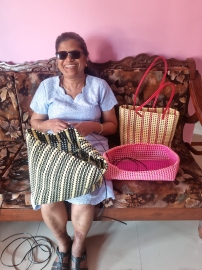
 Luiza D’mello with her plastic half-wire basket bags.
She weaves colourful shopping bags, fruit baskets, pot holders, macramé bags... and the demand for her handmade products is unending. Her hands are always full with orders and as soon a product is complete, it gets sold in no time. So, she never has any stock to display. Luiza D’mello from Saipem, Candolim is known for her weaving skills and she earns through this art without even stepping out of her home. Visually impaired Luiza, who is 57 today, lost her vision when she was 12. However, accepting this biggest challenge that life threw at her, Luiza did not give up, and today is living a content, financially independent life.
Recalling the tragedy that cost her right eye, Luiza shares, ‘I was a normal girl, just like anyone in the neighbourhood. The incident happened when I was in class II. Our teacher had gone out and a girl was asked to monitor the class. She had a stick in her hand, and while she was trying to keep the students silent, the stick accidently poked into my eye. It pained a lot. Seeing my injured eye my mother took me to an ophthalmologist in Panaji. He said that my eye has developed a dot due to the injury, and we have to wait to see if it goes away. The dot did not go away, instead it grew bigger. I could not see. Operations didn’t help. Later I had injury in the same eye. I fell on the steps and accidently hurt it again. The doctor told us that there is infection and the eye has to be removed surgically. So my right eye was removed. I could still manage with my left eye.”
But life sometimes plays nasty jokes, and little Luiza had to face another blow, this time in the left eye which had sight. When she was studying in boarding school at Siolim she experienced that she cannot see with her left eye. “Everything was blurred and faint. My mother was informed. She took me home. The doctor stated that my retina has come down. My father flew from Abu Dhabi. I was taken to Mumbai for treatment. No doctor guaranteed that my left eye could be saved,” recalls Luiza.
Then she was taken to Gujarat for treatment of retina. She had to take injections in the left eye “ one injection per day “ sixty injections after which she underwent surgery for retinal detachment. Her eyesight did not recover. Luiza’s parents left no stone unturned to bring back her lost vision. But since the retina was weak, nothing could be done. She lost both her eyes when she was just 12. The reason for weakening of the retina of the other eye was too much strain. As she used to manage with only one eye there was pressure on the retina. The nerves of this eye became hard and tight. No doctor could restore Luiza’s vision. She was permanently blind in both eyes in 1978.
Wanting to study further, Luiza studied Braille at National School of Blind outlet at Caritas, Old Goa in 1983, did a bridge course till class VIII and completed her SSC through Open School at NAB with the help of cassettes and Braille notes. Her uncle Volley D’mello, also blind, was a Braille teacher at Caritas NAB and Luiza became the first student of NAB Goa where the then presidents, Marian D’Souza, Grace D’Souza and Rossando Mendonsa boosted her morale.
After SSC, Luiza was sent to Mumbai through NAB to be trained in various crafts. She learnt chair caning, broom making and torans. She also learnt to make plastic half-wire basket bags from other girls in the hostel who used to do them in their free time. What she learnt there came a long way in making her financially independent. Until two-three years ago, Luiza was into Rotessao (weaving cane on chairs) but had to stop due to arthritis. Now she continues with plastic half-wire items. Sometimes she displays them in the exhibitions, or keeps them for sale at shops in Porvorim, Caranzalem. People come home to place orders and take deliveries. It takes eight days for a small bag, 10 days for a medium one and 15 days for large size. She earns a decent income through her handcraft. “One should not lose heart at the time of crises, but overcome the hurdles and accept fate with a smiling face. That’s how I have learnt to live,” concludes a brave Luiza.